Things to Do in Seoul at Night: Markets, the River and the Tower After Dark
Seoul does not shut down at sundown. Night markets, a river that stays busy past midnight, a tower open until 23:00 on weekends and, new this month, a free guided city walk over Namsan itself. Here is what runs late, and how late it really runs.
Short answer
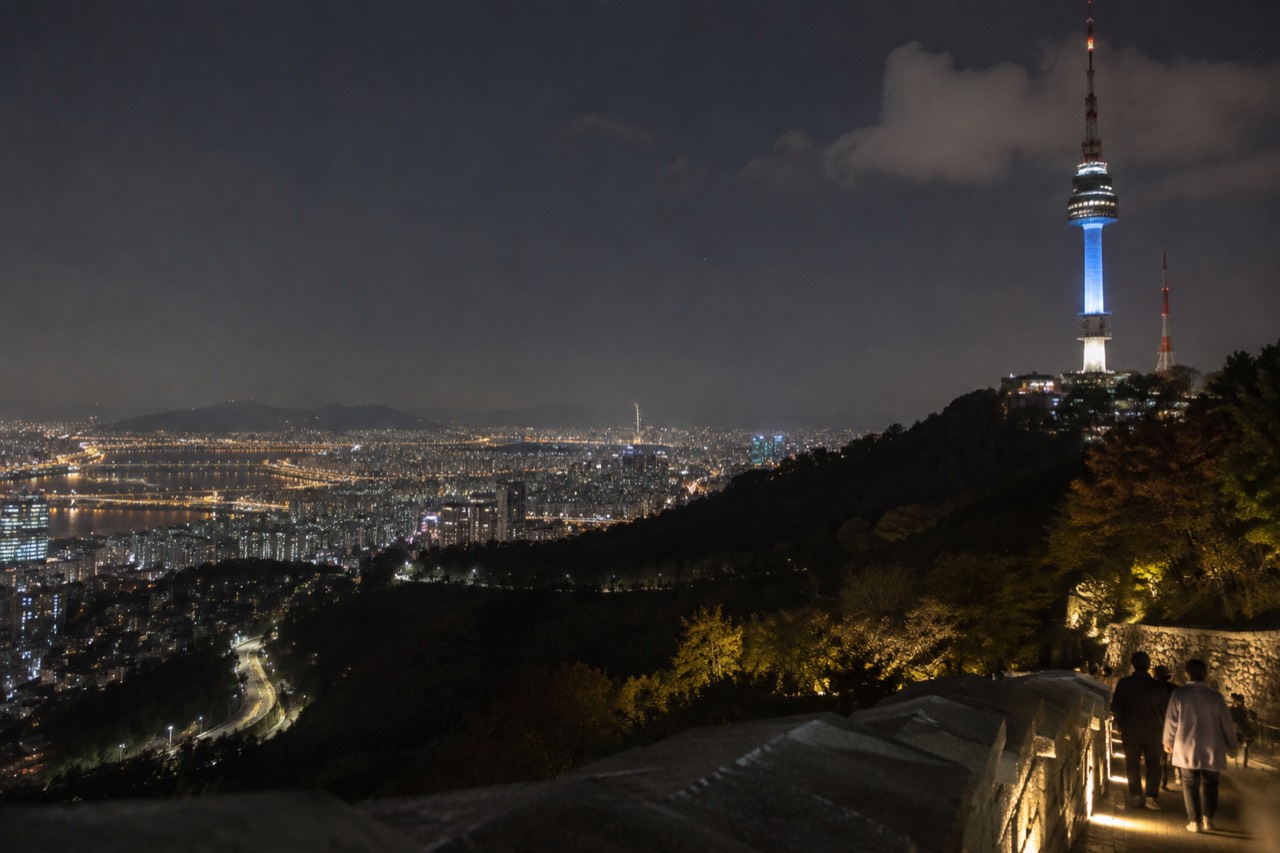
The best things to do in Seoul at night are eating at a night market, riding the Namsan cable car or walking up to N Seoul Tower (observatory open until 22:30 weekdays, 23:00 weekends), and seeing the Han River bridges lit up. A new free guided night walk over Namsan launched in September 2026 with 18:00 and 20:00 departures.
Seoul after dark is not a smaller version of the daytime city. It is a different one. The heat drops, the tower on Namsan lights up, the river bridges switch on, and a whole street-food economy that dozes through the afternoon comes alive. The city's own government now leans into this: in September 2026 it added a free guided night walk over the summit of Namsan, something no guidebook printed before late 2025 could possibly mention, and extended its whole night walking-tour season to run mid-March through mid-November.
This guide orders the main night options by how late they actually run, using the operators' own published hours rather than the optimistic versions that circulate online. The headline facts are simple. The N Seoul Tower observatory closes at 22:30 on weekdays and 23:00 on weekends and public holidays, with last admission 30 minutes before closing. The Namsan cable car runs until 23:00 every day of the year. Beyond the tower, the night markets, the river parks and the new underground cultural spaces each keep their own clocks, and the differences matter when you are planning a single evening.
What is there to do in Seoul at night?
Seoul's main night activities are night markets and street food, the N Seoul Tower observatory (open until 22:30 weekdays and 23:00 weekends, last admission 30 minutes before closing), the Namsan cable car until 23:00, the Han River parks and bridges, the new free guided Namsan night walk at 18:00 and 20:00, and late culture including K-Culture Station, which opened in September 2026. The city keeps more of itself open late than most capitals.
The single most useful way to plan an evening here is by closing time, because the gaps between attractions are large. The tower observatory and the cable car both stop around 22:30 to 23:00, but the night markets in the tourist districts run well past that, and the river parks barely close at all. A sensible order for one evening is the timed thing first, the tower or a guided walk, then food, then the river.
| Night activity | Runs until | Notes |
|---|---|---|
| N Seoul Tower observatory | 22:30 weekdays, 23:00 weekends and holidays | Last admission 30 minutes before closing |
| Namsan cable car | 23:00, every day of the year | Last ticket sold 30 minutes before closing |
| Namsan Ormi inclined elevator | 23:00 | Free; suspended Mondays 09:00 to 14:00 for maintenance |
| Free city Namsan night walk | Departures at 18:00 and 20:00 | Runs daily, mid-March to mid-November |
| Night markets (Myeongdong, Gwangjang area) | Varies by stall, typically past 23:00 | Individual vendors set their own hours |
| Han River parks and bridges | Open ground, no gate | Bridge lighting cycles through the evening |
One boundary worth repeating because so many visitors get it wrong: the mountain is free and the deck is not. Namsan Park, the summit plaza, the terraces around the tower base, the love locks and the Palgakjeong pavilion area all cost nothing. Only the observation deck inside the tower needs a ticket, and only the cable car, the circular bus, parking, food and shopping add cost on top. Our Namsan Park walk up guide covers the free routes in detail.
Where should you eat at night in Seoul?
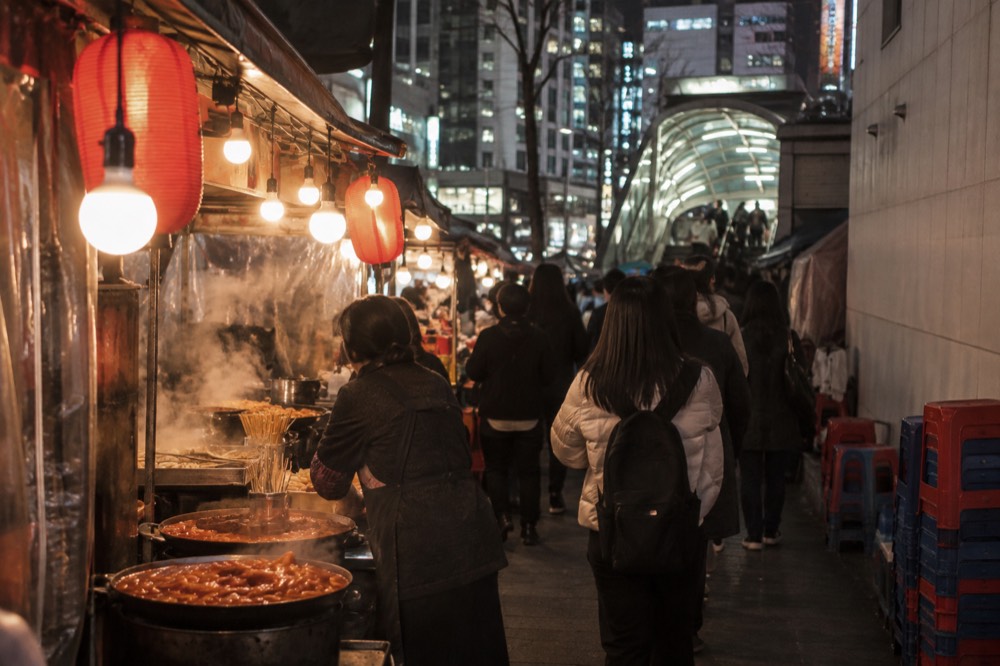
Night markets are the backbone of eating late in Seoul: Myeongdong's street stalls, the Gwangjang Market area's sit-down vendors, and the food streets around the university districts all run deep into the evening, typically past 23:00, with individual stallkeepers setting their own hours. For a sit-down meal with a view instead, the tower itself has restaurants open until 22:00.
Myeongdong is the default answer for visitors staying in the centre, and it earns it. The stalls cluster along the main pedestrian streets, and the neighbourhood has been adding to its retail draw too: Olive Young opened a large Central Myeongdong Town store in March 2026, so the area now stays busy with shoppers as well as eaters well into the evening. The food on offer runs from tteokbokki and hotteok to grilled cheese lobster and fresh pomegranate juice, and the character of the streets changes completely once the stall lights come on.
Gwangjang Market is the other classic. By day it is a fabric and vintage market; in the evening the food alley carries it, and the bindaetteuk and mayak gimbap vendors are the reason people cross the city for it. The stalls here are mostly family-run and keep their own hours, so treat any closing time you read online as a rough guide rather than a schedule.
If you want dinner with the city underneath you, the tower's own restaurants run late: n.Grill serves 12:00 to 22:00 with last order at 20:00, HanCook 12:00 to 22:00 in fixed seatings, and The Place Dining 11:00 to 22:00. An advance n.Grill reservation includes free observatory admission, and dining at HanCook gets a discount on observatory admission, which is worth knowing if a meal was already the plan. Our N Seoul Tower restaurants guide has the full floor-by-floor picture, including N Burger, which reopened in 2026 after its March renewal as a K-style handmade burger house with a Seoul bulgogi burger on the menu.
Is N Seoul Tower worth going to at night?
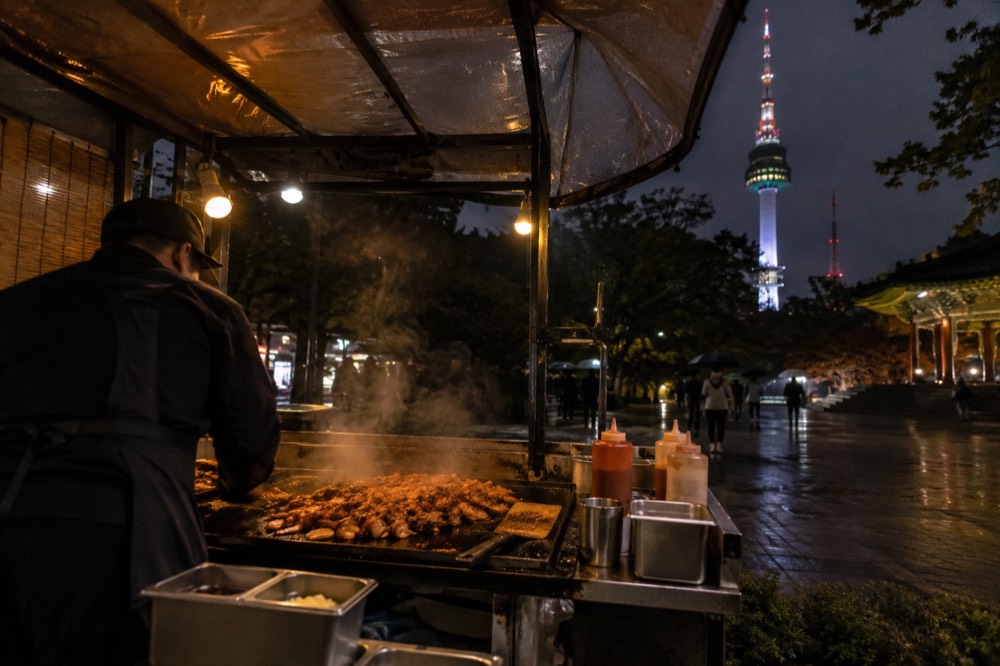
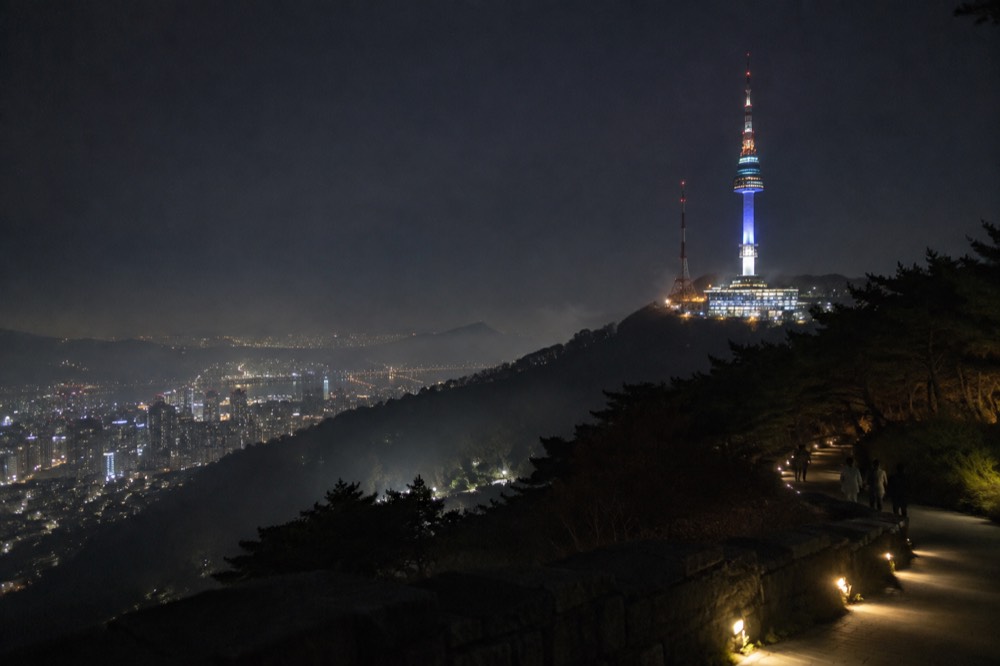
Yes, and the tower's own hours are built for it: the observatory is open until 22:30 on weekdays and 23:00 on weekends and public holidays, 365 days a year, with last admission 30 minutes before closing, and the cable car runs until 23:00. The operator states that on a clear day the deck can see up to 50 km across the city, and at night that becomes a lit grid in every direction.
The tower's appeal after dark is twofold: the view from inside the deck, and the tower itself as the view. The exterior lighting has signalled Seoul's fine-dust level since January 2011, so the colour you see from the street is not purely decorative, though no operator or city source publishes a switch-on time, and the times that circulate in third-party guides just repeat each other. What is verifiable is the closing clock, and it is generous.
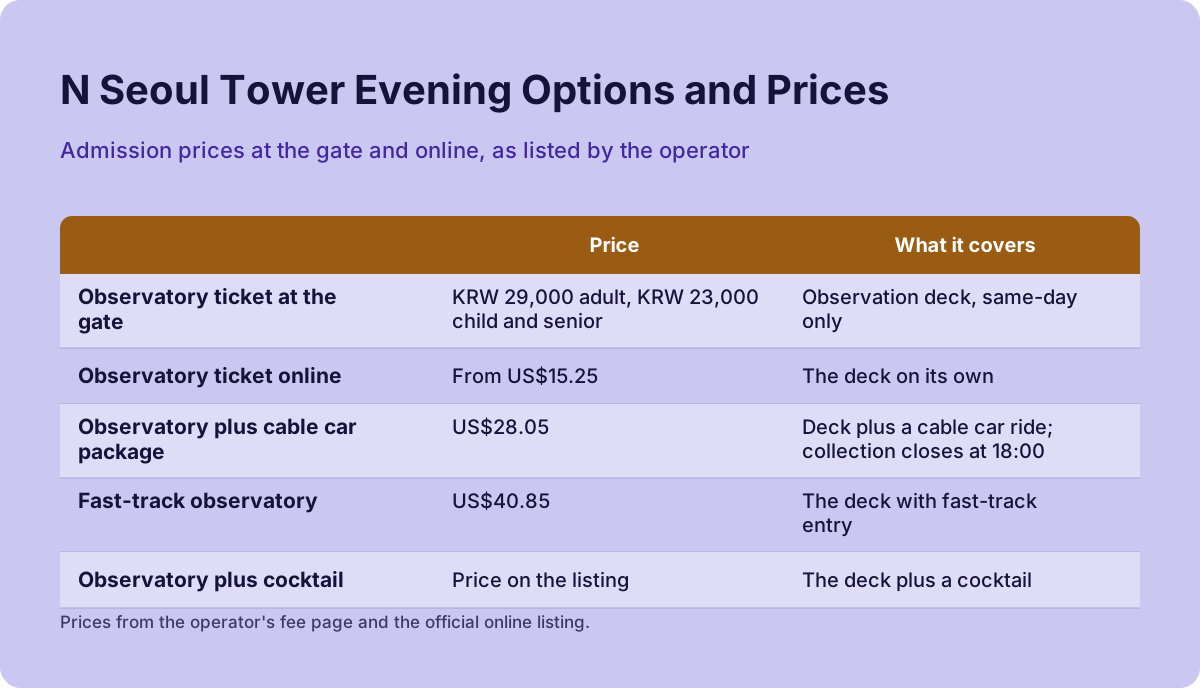
The paid options are straightforward. At the gate, the operator's own fee page lists adult observatory admission at KRW 29,000, with child and senior tickets at KRW 23,000, and tickets are valid on the day of purchase only. Online, the official listing is rated 4.6 across 34,365 reviews and starts at US$15.25 per adult for the observatory ticket on its own. A fast-track version exists at US$40.85, and a package combining the observatory with the Namsan cable car is US$28.05.
| Tower evening option | Price | What it covers |
|---|---|---|
| Observatory ticket at the gate | KRW 29,000 adult, KRW 23,000 child and senior | Observation deck, same-day only |
| Observatory ticket online | From US$15.25 | The deck on its own |
| Observatory plus cable car package | US$28.05 | Deck plus a cable car ride; a physical ticket must be collected at a partner shop in Myeongdong first, and collection closes at 18:00 |
| Fast-track observatory | US$40.85 | The deck with fast-track entry |
| Observatory plus cocktail | No published price | The deck plus a cocktail |
Two honest cautions from the fine print. The online ticket skips the ticket counter, not the mountain: riders still queue for the cable car, and no source anywhere states a wait in clock terms. And a buyer of the fast-track option reported no visible fast-track lane, so treat that option as a convenience purchase rather than a guarantee. Visitors through mid-2026 consistently report that weekends, public holidays and evenings are the busy windows at both the tower and the cable car, and that weekday and early or late visits are the quiet ones.
The free half of the evening should not be skipped, either. The summit plaza, the terraces around the base, the love locks and the walk down to Palgakjeong all cost nothing, and the city's own April feature groups the Locks of Love, the heart chairs and the Palgakjeong night view as free things to do on the mountain. Our N Seoul Tower at night guide goes deeper on the after-dark experience.
The observatory ticket is the simple version of the evening: the deck, the digital telescopes with optical zoom up to 36x on Tower 4F and 5F, and the rotating n.Grill one floor above if a reservation is already in place. The full product is listed at Check availability on the operator's live listing, and the same tour is covered in our observatory ticket guide.
What is the new free night walk over Namsan?
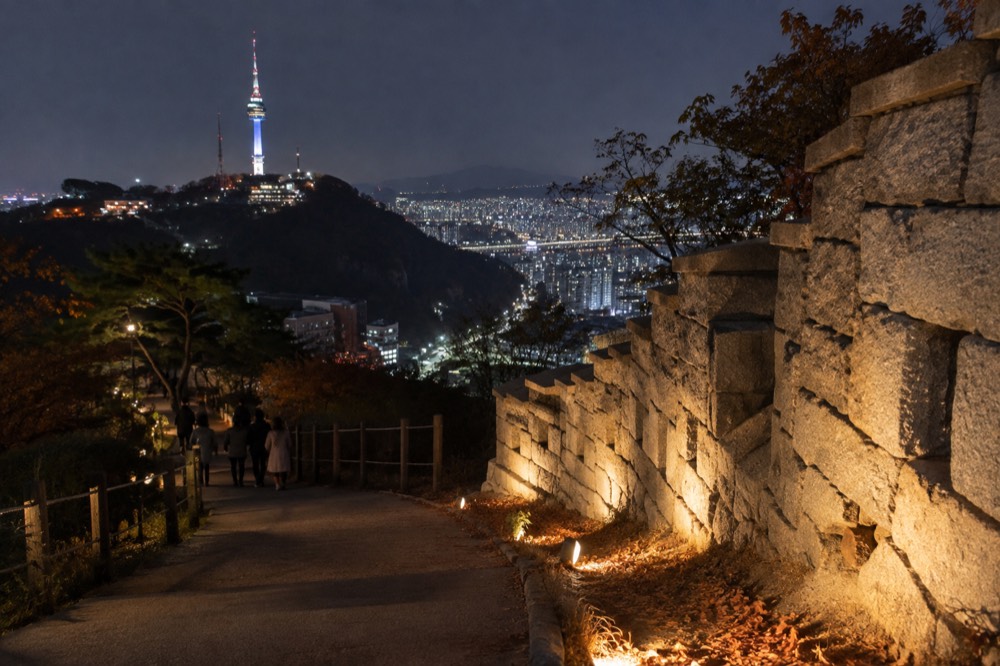
From September 2026, Seoul's free guided walking-tour programme runs a Namsan City Wall night course every day with departures at 18:00 and 20:00, led by a licensed city culture-and-tourism guide, starting near the Sowol poetry monument garden and finishing at Palgakjeong after passing N Seoul Tower and the love lock deck. It costs nothing and is booked in advance through the city's own walking-tour site.
This is the freshest thing on the mountain, and almost nothing published about Namsan mentions it. The city's own description of the route names its stops: it starts at the Namsan Sky Forest Trail entrance near the Sowol poetry monument garden, passes the Zelkova Observatory, the Sunset Observatory and the Wellness Garden, then N Seoul Tower and the love lock deck, and finishes at Palgakjeong. The finish is deliberate: the city linked it to a descent toward Namdaemun Market so walkers can carry on eating there afterwards.
The same announcement extended the whole night-tour season from a summer-only window to mid-March through mid-November, excluding winter, and pushed the later daily departure back to the 20:00 slot. Seoul also introduced free Friday-night special tours at 21:00 on three courses, at Gwanghwamun Square, Cheonggyecheon and the Naksan city wall, aimed at visitors who want the city late. Bookings are made in advance rather than on the day, through the city's own walking-tour pages, and the programme is covered in the city's official announcement.
The trail the walk starts on is itself new. The Seoul Metropolitan Government opened the Namsan Sky Forest Trail on 25 October 2025, a barrier-free timber deck path built with the Korea Forest Service so that wheelchair users and anyone who cannot manage the steep old paths can get up Namsan. As part of the same works the city closed the unofficial side paths that had been worn into the mountain, ecologically restored them, and now directs walkers onto the official trails only, which matters if you arrive expecting to freestyle your way up.
What about the Han River at night?
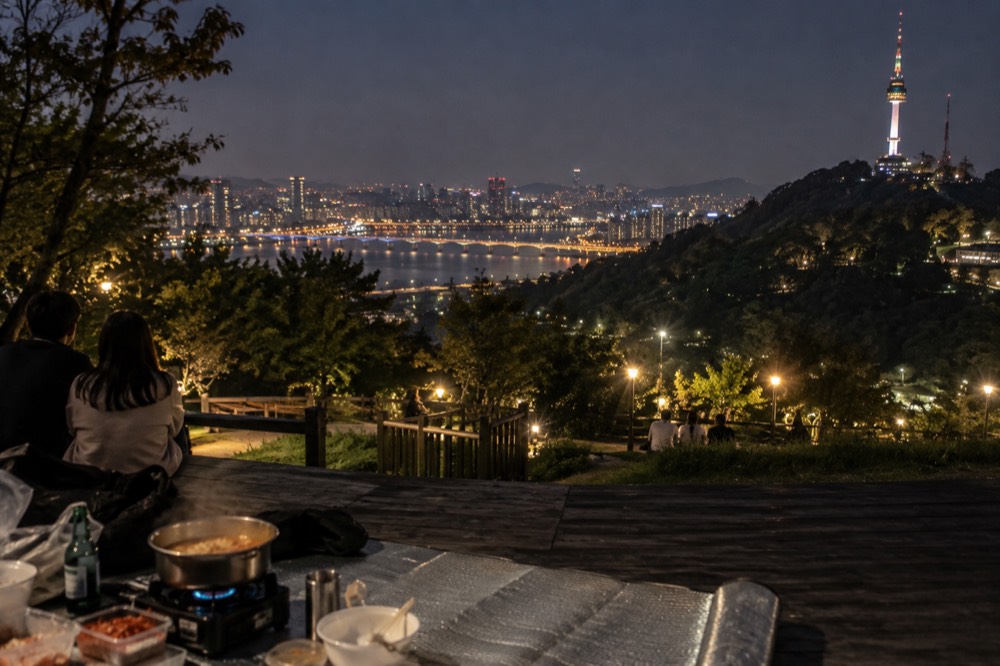
The Han River parks are open ground with no gate or closing time, and the bridges are the show: the city lights its river crossings through the evening, and the riverside parks around them stay busy with cyclists, picnickers and convenience-store ramyeon long after the tower has closed. It is the most flexible item on any night itinerary because it cannot be missed by arriving late.
Ttukseom Hangang Park is the classic spot, and it carries a pop-culture footnote: the 2025 Han River Light Performance drone show there was themed on KPop Demon Hunters, the Netflix film that also staged its climax at a fictional stadium underneath N Seoul Tower. That show ran through September and October 2025 and has finished, but it shows how far the film reached into the city's own programming, and the riverside parks remain the place Seoulites themselves go at night.
Practically, the river works best as the last leg of an evening. The tower stops admitting at 22:00 or 22:30 depending on the day, the markets run past that, and the river has no clock at all. Bring a mat or rent one, buy ramyeon and gimbap from the riverside convenience stores, and pick a bridge to watch. The Hangang Bus is excluded from the city's short-term transport passes, so factor that in if you were planning to ride the river rather than sit beside it.
The fast-track observatory option suits the evening visitor who wants the deck without standing in the ticket-counter line first, though as noted above it does not skip the cable car queue and one buyer reported no visible fast-track lane. At US$40.85 it is the premium version of the standard ticket, and the details are on the operator's live listing.
Can you see the palaces and city wall at night?
Partly. The Naksan city wall is walkable at any hour as open ground, and Seoul's free Friday-night 21:00 special tours cover Gwanghwamun Square, Cheonggyecheon and the Naksan wall, but the palaces themselves keep daytime hours, so the night versions of these sights are the exteriors, the walls and the squares rather than the interiors. The city wall after dark is the underrated one.
Naksan is the practical pick. The wall there sits above Dongdaemun, the walk along it faces the city rather than away from it, and the free Friday 21:00 tour makes it a guided experience rather than a solo navigation exercise. Cheonggyecheon, the restored stream that runs through the centre, is the other night walk that costs nothing: the stream path is open, lit, and lined with Seoulites on warm evenings from its source at Gwanghwamun Square downstream.
For the film-curious, the Korea Times has retraced KPop Demon Hunters' Seoul locations, headed at N Seoul Tower and covering Naksan Park, which the film's "Free" sequence draws on, and Bukchon. Seoul's mayor has publicly tied Namsan's recent surge in interest to the film, saying during an October 2025 visit to the mountain that with its appearance in KPop Demon Hunters, even more domestic and international tourists are expected to visit. Our N Seoul Tower on screen guide covers the film locations in full.
What is K-Culture Station and why is it new?
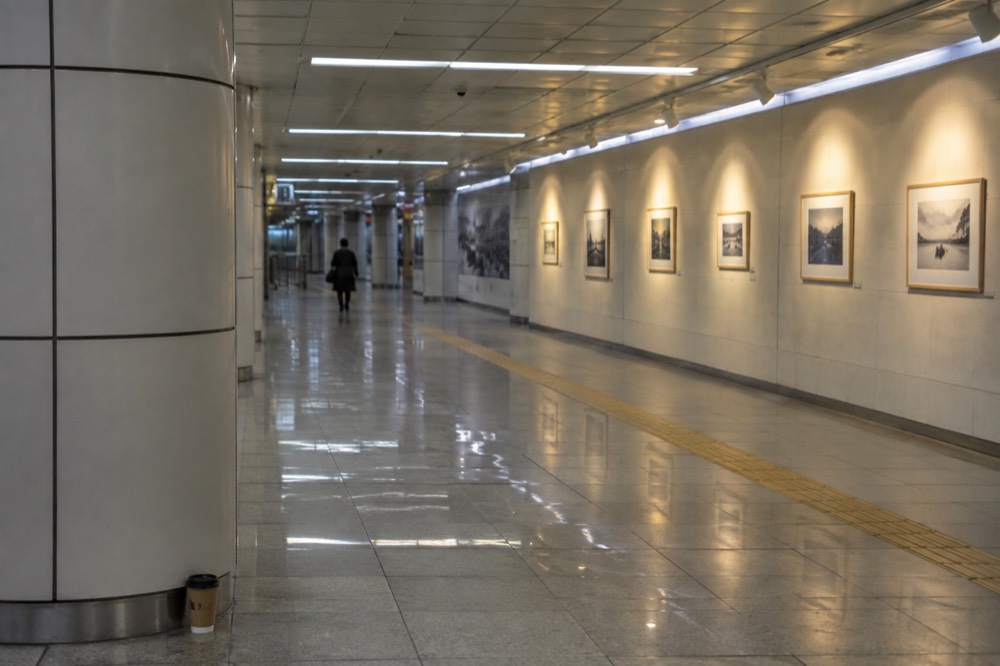
K-Culture Station is a cultural venue that opened on 7 September 2026 inside a 335-metre underground passage that had been sealed for more than four decades, running 13 metres below Seoul Plaza between City Hall and Euljiro 1-ga stations, and launching with an immersive exhibition for Big Bang's twentieth anniversary. It is a short walk from the Myeongdong side of the city centre and no older Seoul guide mentions it.
For a night itinerary it fills a real gap: an indoor, weather-proof, late-evening option between dinner and the river. The venue's opening exhibition is the draw for K-pop fans, but the space itself, a four-decade-old void reopened under the city's main square, is the kind of thing that changes what a central Seoul evening can include. Details are in the Korea Herald's report on the opening.
It is not the only new cultural landmark in the city. Centre Pompidou Hanwha opened in Yeouido on 4 June 2026, a Seoul outpost of the Paris museum, though Yeouido sits further west and fits a day itinerary better than a night one. The pattern is clear either way: Seoul has spent 2026 adding major cultural capacity, and the underground station is the piece that belongs to the night.
For a slower tower evening, the observatory-plus-cocktail option pairs the deck with a drink; its price is on the listing rather than published in advance. N Terrace, the cafe and bar at Tower 1F, reopened in March 2026 after its own short renewal and serves until 20:00, so the cocktail option is the way to have a drink with the view later in the evening.
How do you get around Seoul at night?
The metro and buses run late, taxis are plentiful, and the Namsan circular buses 01A and 01B run until 23:00 from Chungmuro and Dongguk University stations for KRW 1,500 a ride, but the flat-rate 30-day Climate Card that older guides recommend was discontinued: it could be recharged only until 31 August 2026, and its replacement is for Seoul residents only.
The Climate Card change matters because almost every published Seoul itinerary still tells visitors to buy one. The city's own page carries the discontinuation notice and states plainly that eligibility for the replacement Climate Pass is based on place of residence; a visitor cannot use it, and applying through a card issuer with benefits starting the following month rules it out for a short trip anyway. What a visitor can still do is charge short-term passes onto an existing card: the city lists one-, two-, three-, five- and seven-day options, with the fares on the city's official page. The term starts on the day you charge the card, so you cannot load one in advance.
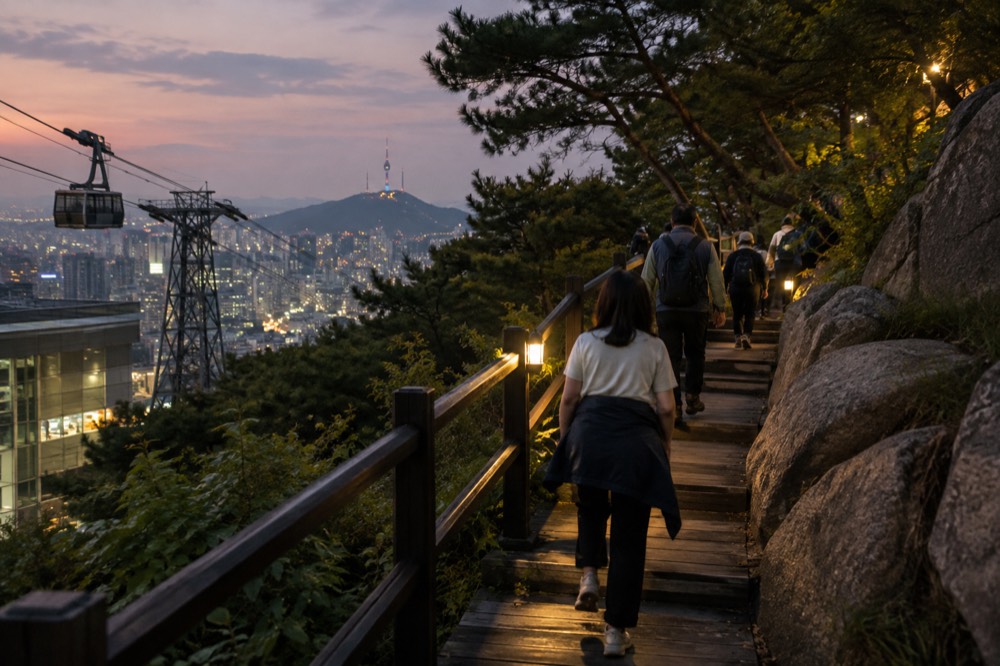
For the tower leg specifically, the practical options after dark are the cable car (10:00 to 23:00, last ticket 30 minutes before closing), the free Namsan Ormi inclined elevator between Namsan Tunnel 3 and the cable car station (09:00 to 23:00, suspended Mondays 09:00 to 14:00), the circular buses, or the walking trails. The cable car company also runs a free shuttle between Myeongdong Station and the cable car platform, first departure 12:00 and last 20:30, which covers the early evening but not the last hours.
| Night transport | Runs until | Cost |
|---|---|---|
| Metro and city buses | Late-night service varies by line | Standard fare |
| Namsan circular buses 01A / 01B | 23:00 | KRW 1,500, transport card |
| Namsan cable car | 23:00, every day | KRW 15,000 adult round trip, KRW 12,000 one way |
| Namsan Ormi inclined elevator | 23:00 (Mon maintenance 09:00-14:00) | Free |
| Cable car Myeongdong shuttle | Last departure 20:30 | Free |
One entry fact worth knowing before you fly: the temporary K-ETA exemption for nationals of visa-exempt countries has been extended until 31 December 2026, so most short-term visitors can enter without applying. Those who do apply anyway get the benefits attached to an approval, including being excused from filling in an arrival card.
Is December a good time for a Seoul night trip?
December nights in Seoul are cold but fully operational: the tower observatory runs its normal hours 365 days a year, the cable car runs every day, and the free Namsan night walk season runs mid-March to mid-November, so it pauses in winter. The city's winter festival dates for the coming season have not been published yet, so plan around the permanent attractions rather than dated events.
That last point is worth being explicit about, because guides love to print festival calendars. As of this month the Seoul Metropolitan Government's English site returns no results for a winter festival page for the coming season. The honest position is that the dates are not out yet, and any page that states them now is guessing. What is certain is the infrastructure: the tower does not close for winter, and the operator's only standing caveat is that hours can change with weather and with Namsan vehicle-access restrictions.
Cold clear winter nights are, if anything, the best viewing conditions the tower gets, and the deck's 50 km clear-day visibility claim is the operator's own. The practical adjustments are clothing and timing: the summit is exposed, the walk down from Palgakjeong is unlit in stretches, and the cable car's glass cabins are heated. Our Seoul in December guide covers the winter city in full, and the three-day Seoul itinerary shows how to slot a tower night into a longer trip.
How much time should a Seoul night take?
A tower evening needs a few hours door to door: the ride or walk up, time on and around the summit, and the descent, with the observatory's last admission at 22:00 weekdays and 22:30 weekends the fixed constraint. A market-plus-river evening with no tower is more elastic, and the free Namsan night walk is a scheduled, guided block with a fixed departure.
Plan the tower first and everything else around it, because it is the only major night attraction with a hard last-entry clock. The 18:00 city night walk departure pairs naturally with a later market dinner, since the route finishes at Palgakjeong with a descent toward Namdaemun Market, which is exactly the dinner the city designed the walk to lead into. The 20:00 departure instead puts you on the summit as the evening crowd builds, and pairs better with a late market snack than a full meal.
For visitors choosing between evenings, the honest comparison is this. The tower is the paid, timed, guaranteed-view option. The city night walk is free, guided, and new enough that almost nobody else on the summit will be on it. The river is free and untimed. A good first night in Seoul does the walk or the tower, then eats, then ends at the river, in that order, and Namsan Tower Seoul covers each of those pieces in its own dedicated guide.
Common questions about Seoul at night
What is there to do in Seoul at night?
Night markets, the N Seoul Tower observatory (open until 22:30 weekdays and 23:00 weekends), the Namsan cable car until 23:00, the Han River parks and bridges, the free guided Namsan night walk at 18:00 and 20:00, and late culture including K-Culture Station, which opened in September 2026.
Is N Seoul Tower open at night?
Yes. The observatory runs 10:00 to 22:30 on weekdays and 10:00 to 23:00 on weekends and public holidays, 365 days a year, with last admission 30 minutes before closing. The cable car runs until 23:00 every day.
What time does the Namsan night walk start?
The free city-guided Namsan City Wall night course runs every day with departures at 18:00 and 20:00, from mid-March through mid-November. It starts near the Sowol poetry monument garden and finishes at Palgakjeong, and is booked in advance through the city's walking-tour site.
Can you still use the Climate Card in Seoul?
No. The 30-day Climate Card could be recharged only until 31 August 2026, and its replacement, the Climate Pass, is available to Seoul residents only. Visitors can still charge one-, two-, three-, five- and seven-day short-term passes onto an existing card.
Is the Han River open at night?
Yes. The river parks are open ground with no gate or closing time, and the bridges are lit through the evening. The Hangang Bus is excluded from the city's short-term transport passes.
Is December a good time for a Seoul night trip?
The permanent attractions run as normal: the tower observatory is open 365 days a year and the cable car runs every day. The free Namsan night walk pauses outside its mid-March to mid-November season, and the city's winter festival dates for the coming season have not been published yet.