Is Seoul Sky The Same As Seoul Tower?
No, Seoul Sky and Seoul Tower are two different attractions in two different districts. Here is what separates them, what each ticket buys, and which one fits your trip.
Is Seoul Sky The Same As Seoul Tower?
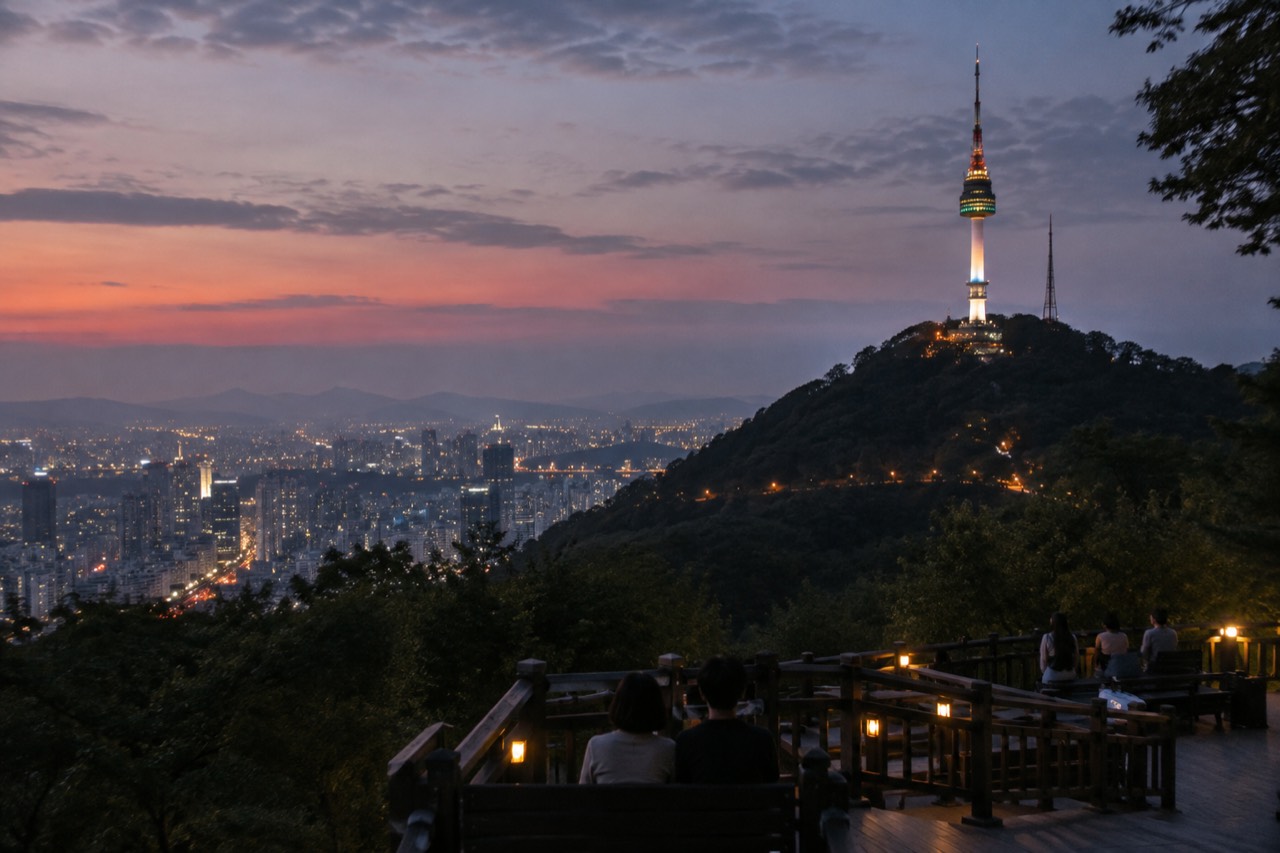
No. Seoul Sky and Seoul Tower are two entirely different observation decks in two different parts of the city. Seoul Sky is the observatory at the top of Lotte World Tower in Jamsil, in the southeast of Seoul. Seoul Tower, properly N Seoul Tower, stands on Namsan mountain in the centre of the city. They have different owners, different tickets and different views.
The confusion comes from the names. Both get called "the tower" by locals and visitors alike, and both sell an observation deck experience, so a first-time visitor reading a rushed itinerary can easily end up buying a ticket for the wrong one. The mix-up goes both ways: people arrive at Namsan asking for Seoul Sky, and people ride out to Jamsil expecting the cable car and the love locks. Neither is there.
The two attractions do not share a district, an operator or a ticket. N Seoul Tower is run from Namsan by the companies behind the tower and its observatory, and its admission is sold on its own terms, which we cover below. Seoul Sky sits inside a supertall mixed-use skyscraper by the Han River, closer to Lotte World and the Jamsil sports complex than to any of the palaces or Myeongdong. If your hotel is in Myeongdong or Jung-gu, one of them is on your doorstep and the other is a metro ride away.
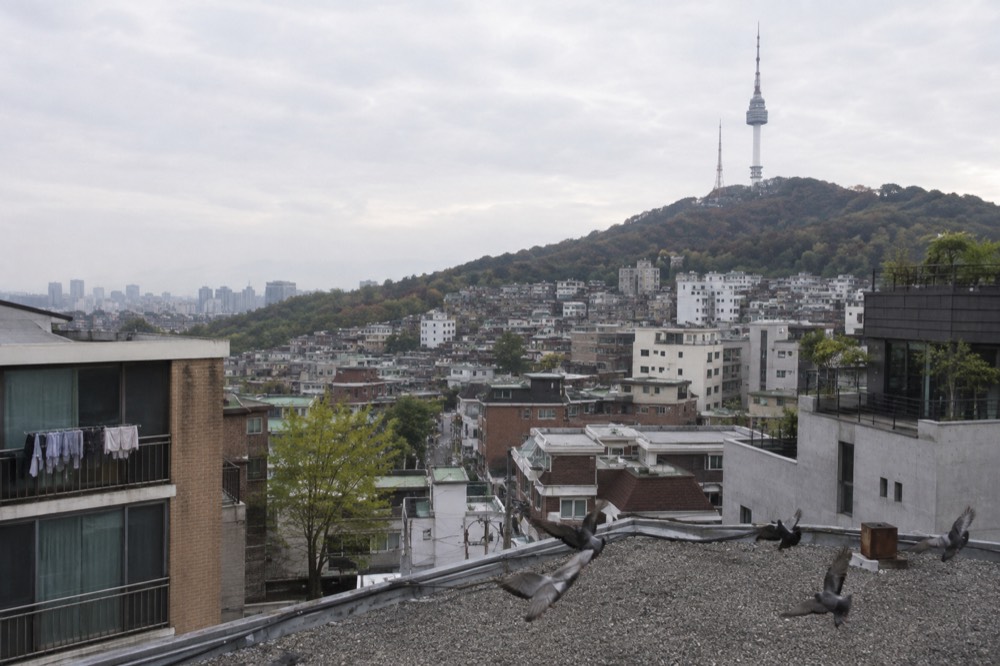
The simplest way to keep them apart is the mountain. N Seoul Tower sits on Namsan, a wooded hill you can walk up for free, and the tower's structure measures 236.7 m on Namsan at 270.0 m, for a total elevation of 506.7 m above sea level, figures published on the operator's own specification page. Seoul Sky has no mountain at all: it is a deck high inside a single skyscraper, reached by lift from a shopping mall podium. One is a hilltop landmark you approach through a park; the other is a vertical ride inside one building.
If you have decided the Namsan one is the tower you want, the observatory ticket options below cover the deck inside N Seoul Tower. The from-price option is the observatory ticket on its own, the fast-track version costs more, and the third option bundles the Namsan cable car, which we explain further down.
Where is each tower, and how do you tell them apart on a map?
N Seoul Tower stands on the summit of Namsan, the large park in central Seoul between Myeongdong and Itaewon, at 105 Namsangongwon-gil, Yongsan-gu. Seoul Sky is at the top of Lotte World Tower in Jamsil, Songpa-gu, on the south bank of the Han River next to the Lotte World complex. On a map, Namsan is the green blob in the middle; Jamsil is far to the east.
Namsan is the largest civic park in Seoul, divided into four districts: Jangchung, Yejang, Hoehyeon and Hannam, according to the city's official tourism site. The tower on its summit is visible from much of central Seoul, and the whole mountain around it is free to enter, a point Seoul's own tourism portal makes plainly. You can reach the summit on foot, by cable car, by the free Namsan Ormi inclined elevator or by the 01A and 01B circular shuttle buses, and only the deck inside the tower itself ever asks for a ticket.
Jamsil is a different world. Lotte World Tower rises out of a retail and entertainment complex that includes an indoor theme park, and the surrounding neighbourhood is flat riverside Seoul rather than hills. The observatory there is a single destination inside one building: you enter, you ride up, you look out, you come down. There is no park, no walk-up option and no summit plaza, because there is no summit.
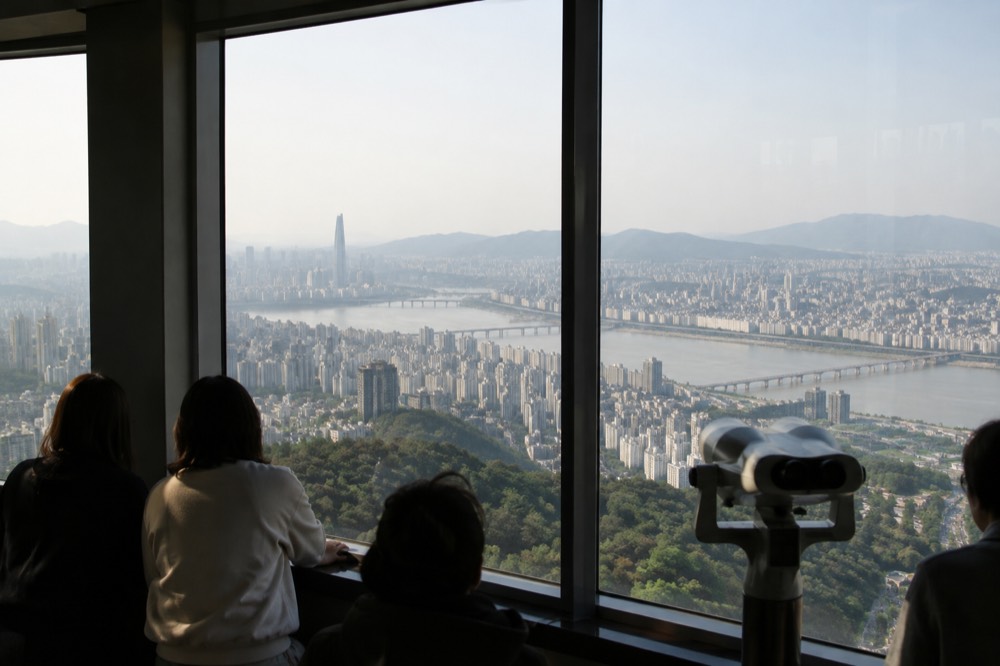
The map test matters for planning because the two towers sit far enough apart that visiting both on the same day eats real travel time. Myeongdong, the usual base for a Namsan visit, is on the central Line 4 corridor. Jamsil is served by Line 2 and Line 8 at the far southeastern edge of the tourist map. If you are staying in Myeongdong or near City Hall, Namsan is the close one; if you are staying near Lotte World or in Gangnam, the calculus reverses.
There is a deeper comparison between the two towers, including how the views and the overall experience differ, in our guide to Lotte Tower versus N Seoul Tower, which goes into the trade-offs in more detail than this piece needs to.
What does each ticket actually buy you?
The N Seoul Tower observatory ticket buys entry to the observation deck inside the tower on Namsan, priced by the operator at KRW 29,000 for an adult, with child and senior rates of KRW 23,000, and from US$15.25 on the live listing. Seoul Sky's ticket buys the deck at the top of Lotte World Tower; its price is on its own listing. Neither ticket works at the other tower.
The Namsan deck is spread across several levels inside the tower. The operator's floor guide lists the observation deck on Tower 5F and Tower 4F, with digital telescopes offering optical zoom up to 36x, a roof terrace and The Place Dining on Tower 2F reachable without an observatory ticket at all, and the entrance gate itself at Plaza 5F beside the information desk and a self-service ticket machine. A Sky Post Office on the deck sells postcards and stamps, with the operator stating domestic delivery takes 2 to 3 days and overseas about 15.
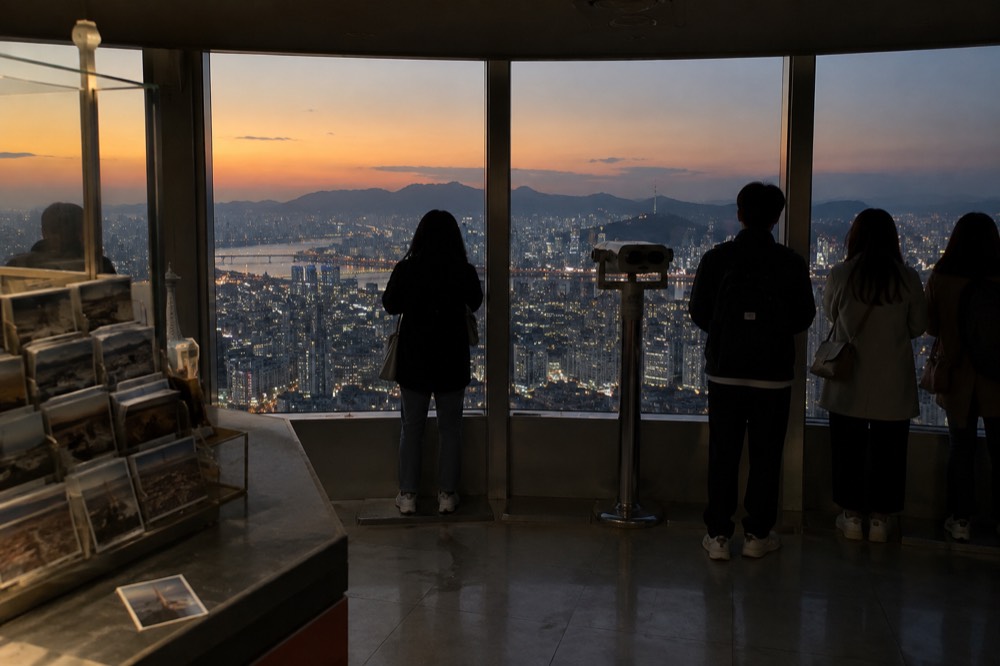
The online ticket for the Namsan observatory, rated 4.6 across 34,365 reviews, is the same deck admission sold in several option bundles. The base observatory option is the from-price choice. A fast-track option costs more, and one honest note on it: what it skips is the ticket counter, not the queues for transport up the mountain, and a buyer of it reported no visible fast-track lane at the deck itself. The third common option pairs the observatory with the Namsan cable car; that pairing is a reseller package rather than an operator product, and it requires collecting a physical ticket at a partner shop in Myeongdong before you ride, with collection closing at 18:00.
Seoul Sky, by contrast, is one deck inside one building, sold on its own listing with its own terms. The two products are not interchangeable and no pass or ticket from one is accepted at the other. If you want both views, you buy both tickets, on separate days or in one ambitious day, and you plan the crossing of the city yourself.
| N Seoul Tower (Namsan) | Seoul Sky (Lotte World Tower) | |
|---|---|---|
| District | Yongsan-gu, central Seoul | Songpa-gu, Jamsil, by the Han River |
| Setting | Summit of Namsan park, reached through free parkland | Top of a supertall skyscraper above a mall complex |
| What the ticket buys | Observation deck levels inside the tower | The deck at the top of the tower |
| Operator admission | KRW 29,000 adult, KRW 23,000 child and senior | Price on the operator's live listing |
| Getting there | Walk, cable car, free Ormi elevator, 01A/01B shuttle bus | Metro to Jamsil and up by lift |
| Around the ticket | Free summit plaza, love locks, trails, beacon mound, shops and cafes | The Lotte World complex below |
One boundary worth repeating, because it is the single most misunderstood fact about Namsan: the mountain itself is free. The park, the summit plaza, the terraces around the tower base, the Palgakjeong pavilion area, the love locks, the Bongsudae beacon mound, the Seoul City Wall path, the Seoul Tower Plaza shops and cafes, the Namsan Ormi inclined elevator and the cable car company's Myeongdong shuttle bus all cost nothing. The paid items are the deck ticket, the cable car if you ride it, the circular bus fare if you take it, parking, and food and shopping. We unpack this fully in our piece on whether it is free to go up Namsan Tower.
Which tower is the famous one with the cable car and the love locks?
That is N Seoul Tower, on Namsan. The cable car, the love locks, the padlock decks, the beacon mound and the rotating n.Grill restaurant all belong to the Namsan tower. Seoul Sky has none of them, because it is a deck inside an office-and-retail skyscraper with no mountain, no cable car and no lock ritual attached.
The Namsan cable car is a separate company from the tower operator, running 10:00 to 23:00 every day of the year with cabins of up to 48 people on a line of about 600 m, and the company presents it as Korea's first passenger cable car, opened on 12 May 1962. Its fares are its own: KRW 15,000 for an adult round trip and KRW 12,000 one way, separate from anything the tower charges. Riders still queue for the cable car even with a pre-bought observatory ticket; what the online ticket skips is the ticket counter, nothing more. The rest of the planning pages sit on Namsan Tower Seoul.
The love locks are equally a Namsan story. The locks are still active, and the strongest recent evidence is that Seoul's own new guided night walk over the summit, launched in September 2026, routes walkers past the love lock deck by name between N Seoul Tower and Palgakjeong. No ban, restriction or closure exists, and no removal programme has been announced by any operator, the city or the press. Visitors report buying locks on site, including branded locks engraved there and then. What nobody can tell you, honestly, is which floor the locks sit on, how many there are or when the practice began: none of that is verified, and any page that states it with confidence is guessing.
If the lock ritual and the cable car ride are part of what you picture when you imagine "Seoul Tower", you are picturing Namsan, and the deck ticket is the paid part of that picture. For everything about the ride up, including the free Ormi elevator and the shuttle bus, our guide to the Namsan cable car covers it in full.
Which one should you visit if you only have time for one?
If you want the classic Seoul panorama with the city skyline wrapped around a wooded mountain, the love locks and the evening cable car ritual, choose N Seoul Tower. If you want the highest man-made viewpoint in the city, inside a single modern skyscraper with a mall below it, choose Seoul Sky. Most first-time visitors with a short stay pick Namsan, because it bundles a park, a landmark and a view into one visit.
The Namsan case rests on the package. You get the walk or the ride up through a real park, a free summit plaza with shops and cafes open to anyone, the locks, the beacon mound and the city wall path, and then, if you choose to pay, a deck that the operator says can see up to 50 km on a clear day, naming landmarks from Bukhansan in the north to Gwanaksan in the south. The tower is open 365 days a year, 10:00 to 22:30 on weekdays and 10:00 to 23:00 on weekends and public holidays, with last admission 30 minutes before closing, which makes it one of the latest viewpoints in the city.
The Seoul Sky case rests on height and modernity: a single ride to a deck near the top of one of the world's tallest buildings, with the Han River spread out below. What it cannot offer is the mountain, and the mountain is more than scenery. It is the reason the Namsan tower exists where it does, on a site the operator lists at 270.0 m to the point where the tower is built, with the 236.7 m structure on top of that.
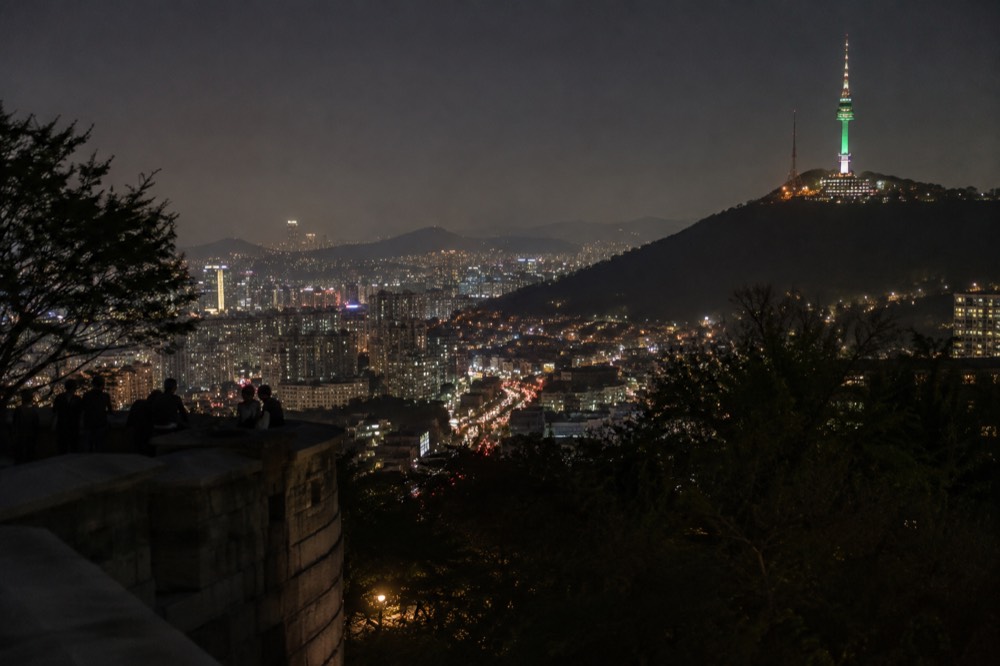
Time of day matters at Namsan in ways worth knowing before you choose. The cable car company's own guidance recommends sunset into night view, and visitor reports through 2026 agree that weekends, public holidays and evenings are the busy windows while weekday mornings and the early or late ends of the day are quiet. No official source anywhere publishes the tower's lighting switch-on time, despite the confident figures that circulate in third-party guides; the only fixed clock facts are the observatory's own closing times. Our piece on Namsan Tower at night versus morning works through the trade-off.
There is also a genuinely new reason to be on Namsan after dark. From September 2026, Seoul runs a free guided night walk over the summit itself, with two evening departures at 18:00 and 20:00, led by a licensed city culture-and-tourism guide, passing the tower and the love locks and finishing at Palgakjeong, booked in advance through the city's own walking tour site. It costs nothing and it is something no published guide to the mountain mentioned a year ago.
Do people confuse them with anything else?
Yes, constantly, and not only with each other. N Seoul Tower also gets called Namsan Tower, Seoul Tower and, by the drama-watching crowd, the tower from countless K-drama rooftop scenes. Seoul Sky gets shortened to "the Lotte tower" or confused with the Lotte World indoor theme park below it. The names blur because both landmarks anchor a view of Seoul that visitors see before they ever learn the proper names.
The naming history of the Namsan tower does not help. The operator's own timeline records that it opened to the public in October 1980, was renamed "N Seoul Tower" in December 2005 after a full renovation, and had already spent a quarter century before that being called simply Seoul Tower by everyone in the city. Three separate organisations still publish official information about the mountain, the tower operator, the tower's owner and the cable car company, and their pages do not always agree on details as small as which metro exit to use.
The name questions have real answers, though, and we have written them out. If you have ever wondered what Namsan means in Korean, or whether Seoul Tower and Namsan Tower are the same thing, those pieces settle it. The short version for this comparison: Namsan is the mountain, N Seoul Tower is the structure on top of it, and Seoul Sky is neither of those things.
A note on the surrounding city, since the two towers anchor different halves of it. Central Seoul around Namsan has its own new draws, including K-Culture Station, a 335-metre underground passage sealed for more than four decades that opened as a cultural venue on 7 September 2026 between City Hall and Euljiro 1-ga. Jamsil's side of the river got its own landmark moment with the opening of a Seoul outpost of a major Paris museum in June 2026. Neither affects the towers themselves, but it tells you the neighbourhoods around them are both moving.
For the Namsan side, the observatory ticket remains the one paid item on the mountain, and the options below are the three most common ways to buy it: the deck on its own, the fast-track version, and the bundle with the cable car that requires the Myeongdong pick-up.
Common questions about Seoul Sky and Seoul Tower
Is Seoul Sky The Same As Seoul Tower?
No. Seoul Sky is the observation deck at the top of Lotte World Tower in Jamsil, Songpa-gu. Seoul Tower, properly N Seoul Tower, is the tower on the summit of Namsan in Yongsan-gu, central Seoul. They are different buildings in different districts with different operators and separate tickets.
Can I use a Seoul Sky ticket at N Seoul Tower?
No. The two observatories are run by entirely separate operators and neither accepts the other's ticket. If you want both views you need two tickets. The N Seoul Tower observatory is priced at KRW 29,000 for an adult at the operator's own gate, or from US$15.25 on the live listing.
Which tower has the cable car and the love locks?
N Seoul Tower, on Namsan. The cable car is run by a separate company with its own fares, and the love lock decks sit around the tower on the free summit plaza. Seoul Sky has neither, as it is a deck inside a skyscraper with no mountain and no lock ritual.
Is Namsan Park free even if I don't buy a tower ticket?
Yes. The park, the summit plaza, the terraces around the tower base, the love locks, the beacon mound, the city wall path, the plaza shops and cafes, the Ormi inclined elevator and the Myeongdong shuttle bus are all free. Only the observation deck inside the tower, the cable car if you ride it, the circular bus fare, parking, food and shopping cost money.
Which tower is better for a first visit to Seoul?
Most first-time visitors choose Namsan, because one visit bundles a park walk or cable car ride, a free summit plaza, the love locks and a classic central panorama, with the deck open until 22:30 on weekdays and 23:00 on weekends. Seoul Sky suits visitors who specifically want the highest man-made viewpoint, and it pairs naturally with a stay near Jamsil or Gangnam.
Are Seoul Tower and Namsan Tower the same thing?
Yes, those two names refer to the same structure. The tower opened to the public in October 1980 and was renamed N Seoul Tower in December 2005 after a full renovation. Namsan is the mountain it stands on, so Namsan Tower, Seoul Tower and N Seoul Tower all point to the same place, and none of them is Seoul Sky.