Walking Up Namsan Park: Routes, Gradients and What You Pass on the Way
Namsan Park is free, open and threaded with walking routes to the summit. This guide covers the three classic trails, the new barrier-free Sky Forest Trail, and the sights on the way up.
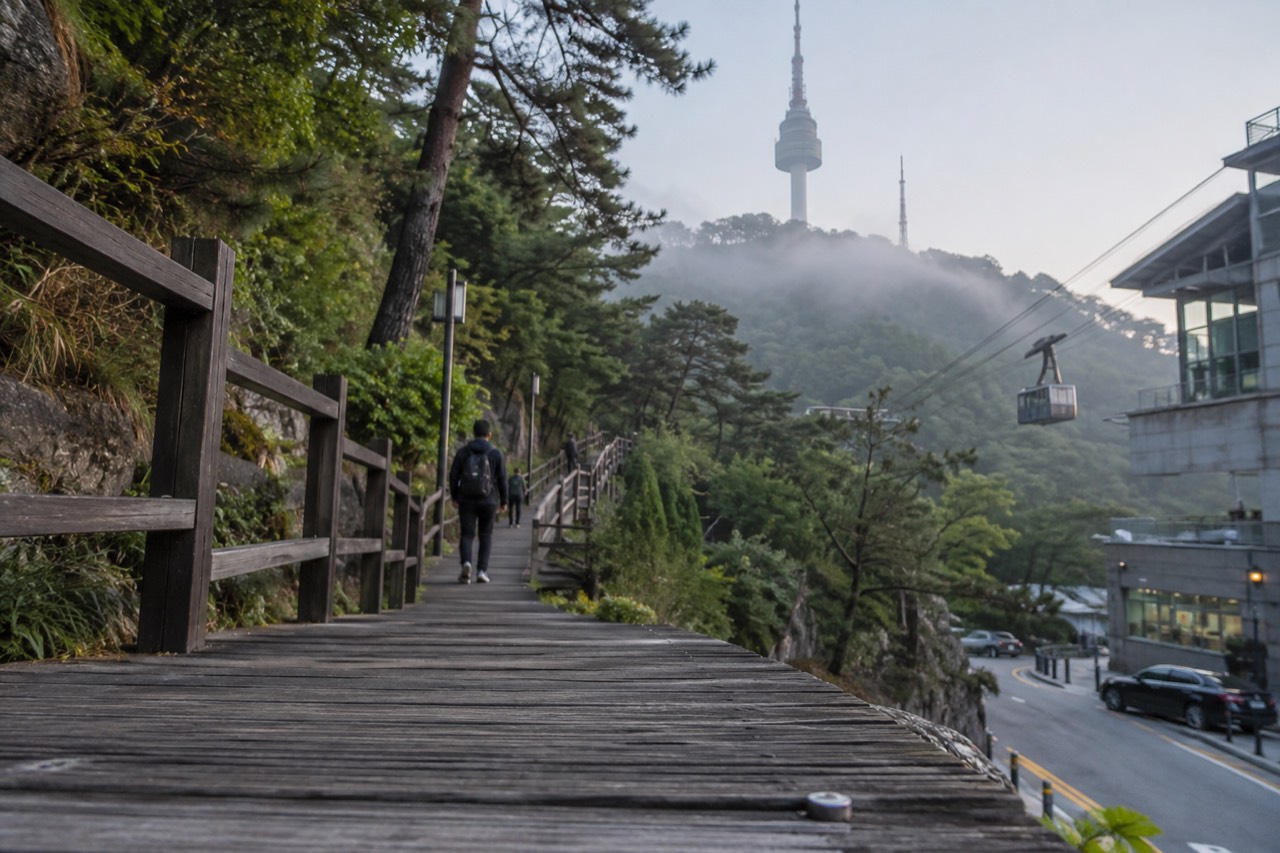
Short answer
Namsan Park is Seoul's largest civic park and costs nothing to enter. Four signed summit trails take 30 to 40 minutes each, per the tower company's own figures. Only the observation deck inside N Seoul Tower is ticketed, from US$15.25 online; the summit plaza, love locks and views from the base are free.
Namsan Park covers the whole mountain that N Seoul Tower stands on, and it is the largest civic park in Seoul, divided into four districts: Jangchung, Yejang, Hoehyeon and Hannam. Seoul's official tourism site states it plainly: the entrance to Namsan Park is free. The walk up is a genuine Seoul experience in its own right, a forested climb in the middle of a megacity that ends at a summit plaza, a beacon mound from the Joseon era and one of the most recognisable towers in Asia.
What trips many visitors up is the boundary between the free mountain and the paid deck. The trails, the plaza, the terraces, the love locks and the views from the base all cost nothing. The only thing a ticket buys is the observation deck inside the tower itself. This guide walks through the routes, the gradients, the only officially published walking times, and what the park holds along the way. For everything about the ride up rather than the walk, see the companion guide to the Namsan cable car.
What does walking up Namsan Park actually involve?
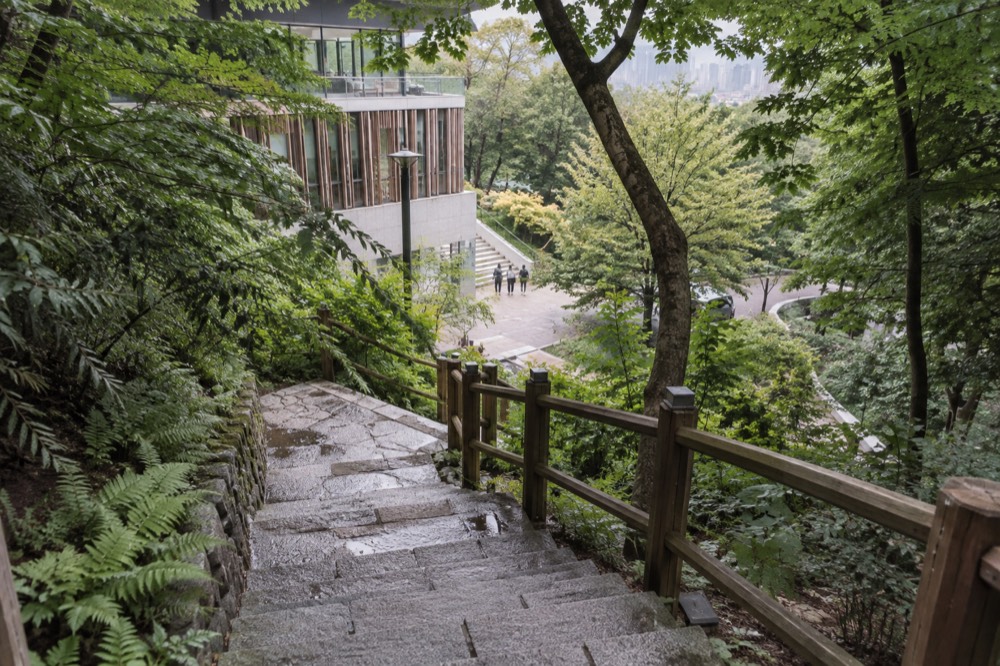
Walking up Namsan means a steady, forested climb on signed trails to a summit at 270 metres, where N Seoul Tower stands. The park is free, open year round, and private cars have been barred since 1 May 2005, so the mountain belongs to walkers, shuttle buses and the cable car. Four named trails reach the top, each taking 30 to 40 minutes.
The mountain is not a wilderness, but it is not a city street either. The trails run under a mature tree canopy, past restored sections of the Seoul City Wall, a Joseon-era beacon station and, since late 2025, a new barrier-free timber deck path. The gradient is real: Namsan rises from the surrounding streets to the 270 metre summit where the tower is built, and the tower structure itself adds another 236.7 metres, giving the famous total elevation of 506.7 metres above sea level. If the height figures interest you, the guide to how tall N Seoul Tower is untangles them.
One thing has changed recently that older guides miss. As part of the same city works that built the new deck trails, Seoul closed the unofficial side paths that had been worn into the mountain, ecologically restored them, and now directs walkers onto the official trails only. Arrive expecting to freestyle your way up a dirt shortcut and you will find it fenced off. The official routes are the ones described below, plus the new barrier-free trail, and they are all the city wants you on.
Weather and hours matter less than you might fear. The park itself has no gate or closing time, and the tower is open 365 days a year, with the observatory running 10:00 to 22:30 on weekdays and 10:00 to 23:00 on weekends and public holidays. The operator notes that hours can change with weather and with Namsan vehicle-access restrictions, so a rough-weather day can affect services on the mountain even when the park stays open.
The Sam-soon Steps: the famous staircase route
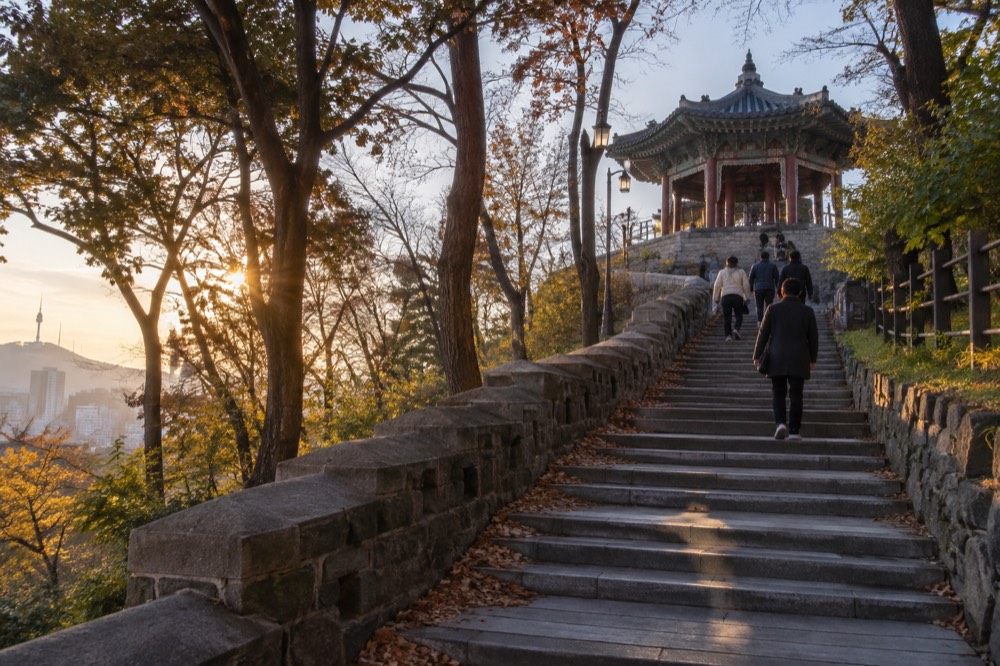
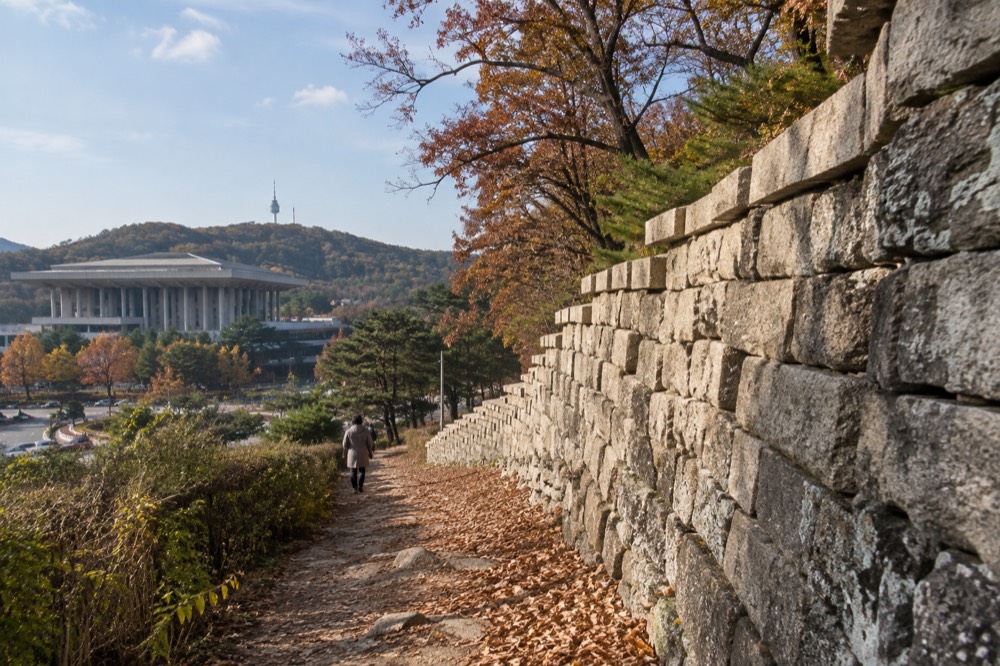
The Sam-soon Steps climb from beside the Seoul Education Research and Information Institute up to Palgakjeong, the pavilion near the summit, and the tower company's own timing puts them at 40 minutes. They are the best known of the walking routes, named after the drama "My Lovely Sam-soon", which filmed its staircase scenes here.
The steps are exactly what they sound like: a long, continuous staircase through the trees, steeper in places than the winding road alternatives and more direct because of it. The operator that runs the tower building attaches the drama association itself, which is the one screen connection on this mountain that a primary source supports. Visitors who come specifically because of a certain animated film should know that the tower's on-screen history is broader than most guides report, and the N Seoul Tower on screen guide covers what is actually verified.
Forty minutes is the tower company's figure for the full climb to Palgakjeong, and it is one of only four summit trail times with a named official source. Treat it as a planning number for a reasonably fit walker, not a promise. The steps are shaded almost the whole way, which matters in Seoul's summer, and they come out near the pavilion and the plaza in front of it, the same open ground the tower operator directs picnickers to, since outside food is not allowed inside the tower itself.
If you climb the Sam-soon Steps you will arrive at the summit with no ticket and nothing owed, and the choice of whether to enter the deck is entirely yours at the Tower 1F ticket booth or the Plaza 5F entrance. Many walkers treat the staircase as the way up and the cable car or the circular bus as the way down, which is a sensible pairing of legs and gravity.
The Namsan Public Library route: the cherry blossom path
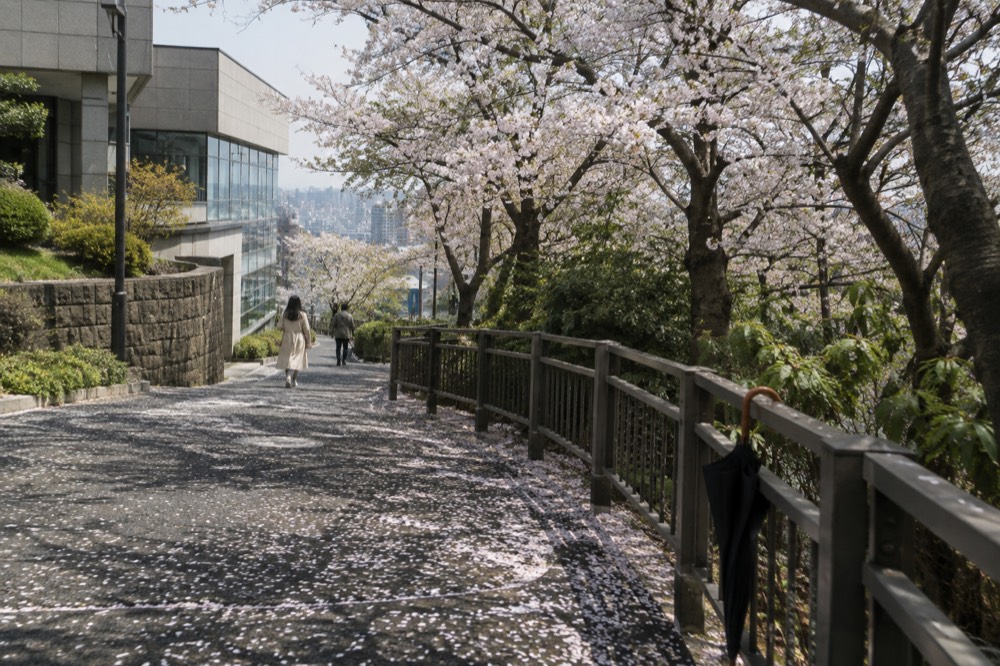
From the entrance to the Southern Circuit in front of the Namsan Public Library, the trail to the summit takes 30 minutes on the tower company's timing, making it the quickest of the classic routes. In April this is also the park's celebrated cherry blossom path, the stretch from the library up to N Seoul Tower that Seoul city itself names as a famous blossom spot.
The library route is the one Seoul's own government features when it writes about Namsan in spring. The city describes the path from Namsan Public Library up to the tower as a famous cherry blossom walk, and the library frontage is where the Southern Circuit trail begins. Thirty minutes is the official figure for the climb. The route is gentler in feel than the Sam-soon Steps because it follows the circuit road and trail rather than a pure staircase, though it still gains the same height.
One honest caveat on blossom timing: no Namsan-specific bloom date exists anywhere. The Korea Meteorological Administration's figures are Seoul-wide, measured at a standard King cherry tree at the Seoul Weather Observatory, with a long-term average of flowering on 8 April and full bloom on 10 April, and in 2025 Seoul flowered on 4 April. Those dates describe the city's standard tree, not the trees on this mountain. If you plan an April walk, treat the KMA's Seoul average as a rough guide and the library path as the right trail to be on when the blossom comes.
The library itself sits on the southern side of the mountain, which also makes this route the natural pairing with the National Theater trails described below, since both start from the same flank of the park. Walkers coming from Itaewon or the south of the city will usually find this the most convenient starting point.
The National Theater routes: two options from the east
The National Theater of Korea gives you two trails. From the theatre ticket booth via the Southern Circuit, the climb is 40 minutes. The steps beside the theatre, joining the Southern Circuit then turning right up the steps, take 30 minutes. Both are on the tower company's own walking page.
The theatre is the eastern gateway to the park, close to Jangchung district and the Jangchungdan area at the foot of the mountain. The two options from here split by character rather than by much time: the circuit-road route from the ticket booth is longer in distance and steadier in gradient, while the steps beside the theatre cut up more directly and save roughly ten minutes on the official timings. Choose the steps if you want the quickest climb from this side, the circuit if you prefer a gentler slope.
This flank of the mountain is also where some of the park's history sits thickest. The Jangchung district contains the trailheads, and the walk up passes close to the restored Seoul City Wall, Historic Site No. 10, whose trail runs from Sungnyemun to Jangchung Gymnasium. The wall sections on Namsan are among the most photogenic stretches anywhere in Seoul, and photographers planning a summit visit will find more framing ideas in the N Seoul Tower photo spots guide.
For walkers who want the deck at the top rather than just the summit air, the observatory ticket is the same product however you arrive: the official listing is rated 4.6 from 34,365 reviews and starts at US$15.25 per adult.
The Namsan Sky Forest Trail: the new barrier-free route
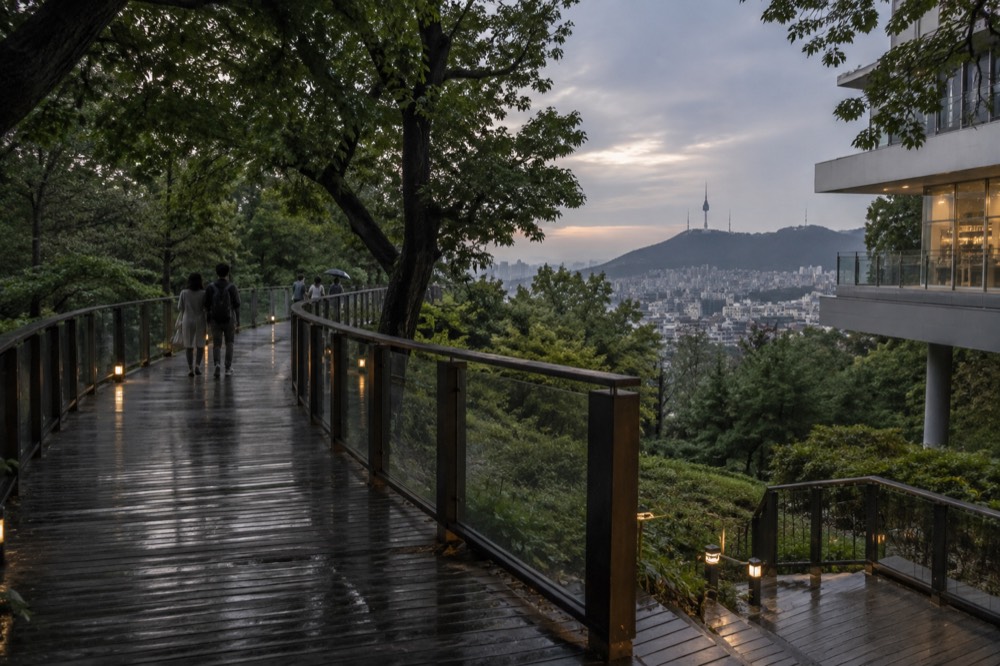
Seoul opened the Namsan Sky Forest Trail on 25 October 2025: a barrier-free timber deck path that links the Huam-dong Namsan Fitness Center to the Namsan Library, built so wheelchair users, older visitors and anyone who cannot manage the steep old paths can get up the mountain. It was built with the Korea Forest Service, which provided the national forest land while the city paid for the work.
This is the biggest change to walking on Namsan in a generation, and almost nothing published before late 2025 knows it exists. The trail is a timber deck path, level enough for wheels, and it comes with its own set of named stops: the Sunset Observatory, a glass-fenced sky-view photo point; the Wind View Bridge, looking over a metasequoia stand; a Pine Rest Area; a Wellness Garden with a Starlight Marronnier Forest and meditation gardens; and Sowol Garden at the Namsan Library entrance, built around the Kim Sowol poetry monument. The city's own night-tour page adds a Zelkova Observatory to the list. Everything else covered here is indexed on Namsan Tower Seoul.
Two shorter deck sections were completed in the first half of 2025 as part of the same programme: a safety deck along the southern circular road between the Octagonal Information Center and the Fitness Center, and a northern forest trail running from N Seoul Tower down to the northern circular road. The two source reads disagreed on the exact month, so no month is given here. Together with the Sky Forest Trail they mean the mountain's walking infrastructure is newer than nearly every guide to it.
The trail also matters for a second reason: it is now the start of the city's own guided night walk. From September 2026, Seoul's free walking-tour programme runs a Namsan City Wall night course with two evening departures, at 18:00 and 20:00, every day. It starts at the Sky Forest Trail entrance near the Sowol poetry monument garden, passes the Zelkova Observatory, the Sunset Observatory and the Wellness Garden, then N Seoul Tower and the love lock deck, and finishes at Palgakjeong, deliberately positioned for a descent toward Namdaemun Market. A licensed city culture-and-tourism guide leads it, and booking is made in advance through the city's own walking-tour site. The city announced the course through its media hub, and the whole night-tour season now runs mid-March through mid-November.
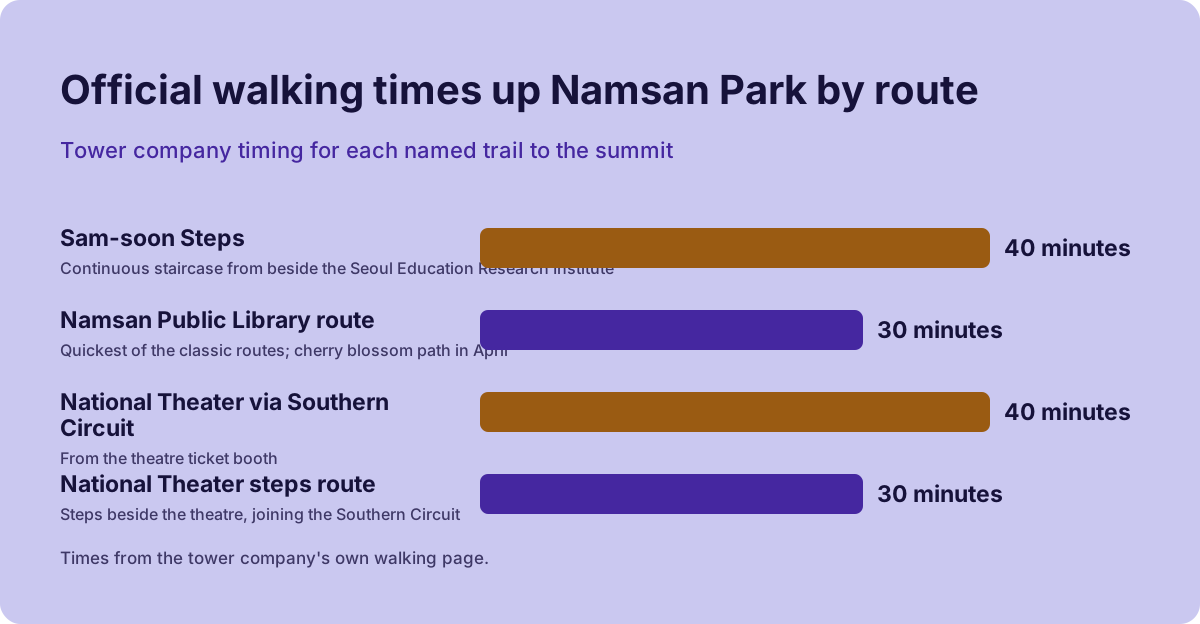
| Route | Start point | Official time | Character |
|---|---|---|---|
| Sam-soon Steps | Beside the Seoul Education Research and Information Institute | 40 minutes | Continuous staircase, shaded, drama-famous |
| Namsan Public Library | Southern Circuit entrance in front of the library | 30 minutes | Circuit trail, the cherry blossom path |
| National Theater, ticket booth | Theater ticket booth via the Southern Circuit | 40 minutes | Steadier gradient on the east flank |
| National Theater, steps | Steps beside the theater, Southern Circuit then right | 30 minutes | Quicker, more direct climb |
What is free on the mountain, and what is not
Everything that gets you up Namsan on foot, and everything at the summit except the deck inside the tower, is free. That means the park and its trails, the summit plaza and terraces, the Palgakjeong pavilion area, the love locks, the Bongsudae beacon mound, the Seoul City Wall path, the Seoul Tower Plaza shops and cafes, the Namsan Ormi inclined elevator and the cable car company's Myeongdong shuttle bus.
The paid list is short: the observation deck ticket, the cable car if you ride it, the Namsan circular bus fare if you take it, parking, and food and shopping. The observatory's own admission, from the operator's fee page, is KRW 29,000 for adults and KRW 23,000 for children and seniors, with under-36-months free. Online, the same deck is bookable from US$15.25 per adult. Both prices are stated here as themselves, because comparing them numerically is exactly the kind of arithmetic this site refuses to do.
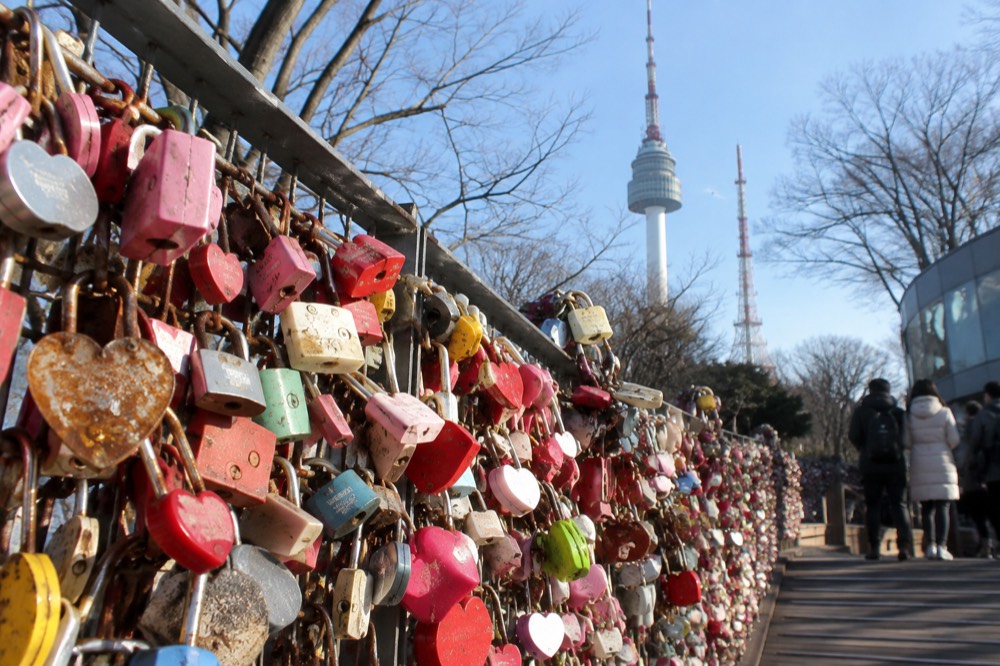
The free side is not a consolation prize. The summit plaza is where the love locks are, and they are active: Seoul's own new night walk routes walkers past the love lock deck by name, and the city's visitor page for the tower still lists the Locks of Love among its attractions. Visitors report buying padlocks on site, including branded locks engraved there. What nobody can tell you is whether the locks are ever cleared: no operator, city or news source has announced any removal programme, and no source says they are cut on a cycle. The honest answer to "do they remove the locks" is that nothing has been announced, in either direction.
| Free on Namsan | Paid on Namsan |
|---|---|
| All park trails, including the Sky Forest Trail | Observation deck inside the tower |
| Summit plaza, terraces and Palgakjeong area | Cable car, if you ride it |
| Love locks and the views from the base | Circular bus 01A/01B fare, KRW 1,500 |
| Bongsudae beacon mound and Seoul City Wall path | Parking at the lots around the mountain |
| Seoul Tower Plaza shops and cafes | Food and shopping |
| Namsan Ormi inclined elevator |
The Ormi deserves a word of its own. It is a glass-walled slanted outdoor elevator running between Namsan Tunnel 3 and the cable car station, free of charge, operating 09:00 to 23:00 with a maintenance suspension every Monday from 09:00 to 14:00, and also suspended in strong wind or heavy rain. It began operating on 30 June 2009, built by the Seoul Metropolitan Government to improve pedestrian access. It is not a way to the summit, but it removes the steepest stretch between the street and the cable car, which matters if the walking routes above are more mountain than you wanted. The full picture of rides, buses and shuttles is in how to get to N Seoul Tower.
For walkers who want the deck but not the queue at the ticket counter, there is also a fast-track option at US$40.85. One buyer of it reported no visible fast-track lane, so treat it as a ticket-counter skip and nothing more.
What the park holds on the way up
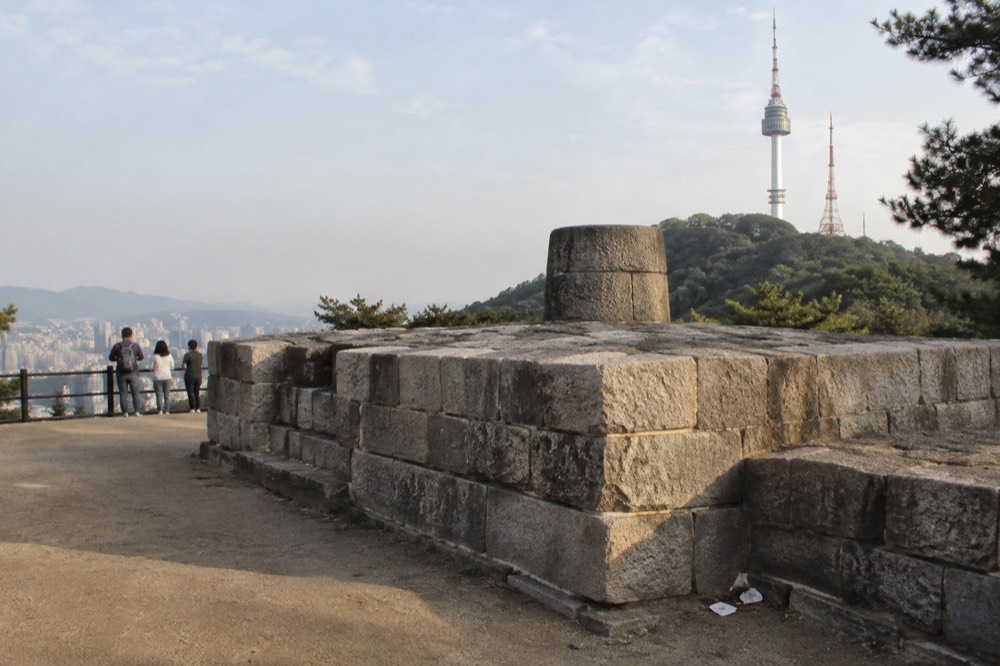
Namsan Park is layered with history rather than rides. On and around the mountain sit the Bongsudae beacon mound, a restored Joseon-era signal station designated Seoul Monument No. 14; the Seoul City Wall trail, Historic Site No. 10; Baekbeom Square with its Kim Koo statue, created 1968; Waryong Shrine, Seoul Folk Material No. 5; and the Ahn Jung-geun Memorial Museum.
The Bongsudae is the most atmospheric of these. It is a restored beacon station of the kind that once carried smoke and fire signals across Joseon-era Korea, sitting below the tower near Palgak Square, and it gives the summit a historical depth that predates the tower by centuries. The Seoul City Wall, meanwhile, wraps the mountain's flanks, and its Namsan sections are where the wall's ridge-line character shows best, running from Sungnyemun to Jangchung Gymnasium.
The Ahn Jung-geun Memorial Museum, at 91 Sowol-ro in Jung-gu, commemorates the independence activist, and opens 10:00 to 18:00 from March to October and 10:00 to 17:00 from November to February. Waryong Shrine and Baekbeom Square round out a set of sites that make the walk up more than exercise: this is a mountain of memorials as much as views.
The tower end of the mountain has its own layer. The Sowol-ro and library side connects to the poetry garden at Sowol Garden, built around the Kim Sowol monument, and the new Sky Forest Trail's stops, the Sunset Observatory and the Wind View Bridge among them, have added a set of purpose-built viewpoints that did not exist a few years ago. The city's decision to restore the worn-in unofficial paths and fence them off means the sights are now all on the official network, which makes planning simpler even if it removes some of the scruffier shortcuts.
One attraction that will not be on your walk: the Teddy Bear Museum closed permanently on 30 November 2013, per the operator's own notice, and no guide should send you looking for it. What is confirmed operating at the top is listed in the N Seoul Tower restaurants and observatory guides, from n.Grill on Tower 7F, whose dining room rotates once every hour and 40 minutes, down to the Seoul Tower Plaza food court, which anyone can use with no ticket at all.
Which route should you choose, and what if you cannot walk it?
Choose the Sam-soon Steps for the classic staircase climb, the library path for blossom and speed, the National Theater steps for the quickest eastern ascent, and the Sky Forest Trail if you need a barrier-free gradient or want the newest path on the mountain. If walking up is not an option, the circular buses 01A and 01B, the cable car and the Seoul City Tour Bus all reach the summit.
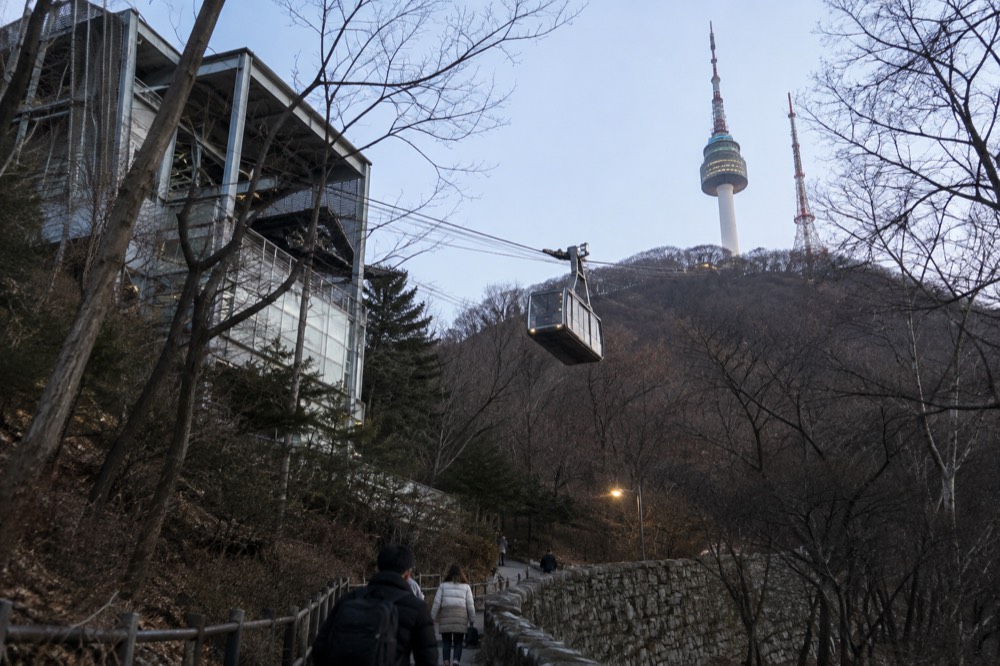
The two circular buses board at Chungmuro Station (Lines 3 and 4) or Dongguk University Station (Line 3) and stop at N Seoul Tower, for a fare of KRW 1,500, with 01A running every 9 minutes and 01B every 14 minutes, both operating 06:30 to 23:00. 01B also serves the Namsan Cable Car and the walking-trail entrance stop. The cable car runs 10:00 to 23:00 every day of the year, with adult fares of KRW 15,000 round trip and KRW 12,000 one way. The Seoul City Tour Bus's Downtown, Palaces and Namsan course also stops here, first bus 09:20, last 16:50, every 30 minutes.
For anyone weighing the ride against the walk, the honest framing is this: the walk is free, forested and takes 30 to 40 minutes on any of the four classic trails, while the cable car is a paid ride with boarding waits that the cable car company itself says can get long at weekends. Whether the ride is worth it is a question with arguments on both sides, argued out in is the Namsan cable car worth it.
Crowding follows a pattern visitors consistently report: weekends, public holidays and evenings are the busy windows at both the tower and the cable car, while weekday visits and the early or late ends of the day are the quiet ones. The cable car company's own advice matches, naming mornings as quieter than afternoons. No source anywhere states a wait in clock terms, so none is given here.
There is also a bundle worth knowing about if you plan to ride up and go into the deck: an observatory-plus-cable-car option at US$28.05, which requires collecting a physical ticket at a partner shop in Myeongdong first, and collection closes at 18:00. It is a reseller package rather than an operator product, and reviewers disagree about whether the cable car leg is round trip or one way, so read the listing carefully before choosing it.
| If you want... | Take... | Official time or fare |
|---|---|---|
| The classic staircase | Sam-soon Steps | 40 minutes |
| Cherry blossom in April | Namsan Public Library route | 30 minutes |
| Quickest climb from the east | Steps beside the National Theater | 30 minutes |
| A barrier-free gradient | Namsan Sky Forest Trail | No published duration |
| No walking at all | Circular bus 01A/01B | KRW 1,500 |
| The ride with a view | Namsan cable car | KRW 12,000 one way, KRW 15,000 round trip |
A last note for evening walkers. The city's new night walk means the summit now has a scheduled, guided, free evening presence it never had before, with departures at 18:00 and 20:00 daily through the extended season. If you would rather have the mountain to yourself, go early on a weekday. If you would rather have a licensed guide, a wall, a tower and a descent into Namdaemun Market at the end of it, book the city's walk. Either way, the mountain costs nothing, and the only decision that carries a price is whether to step inside the tower at the top.
Common questions about walking up Namsan Park
Is it free to walk up Namsan Park?
Yes. Namsan Park is free to enter, and every trail to the summit, the summit plaza, the love locks, the Bongsudae beacon mound and the Seoul City Wall path cost nothing. Only the observation deck inside N Seoul Tower is ticketed.
How long does it take to walk up to N Seoul Tower?
On the tower company's own timings, the four classic trails take 30 to 40 minutes each: the Sam-soon Steps 40 minutes, the Namsan Public Library route 30 minutes, the National Theater circuit route 40 minutes and the steps beside the theater 30 minutes.
Is it hard to walk to the N Seoul Tower?
The trails are a genuine uphill climb, steady and shaded rather than alpine, and the staircase routes are steeper than the circuit ones. The new barrier-free Sky Forest Trail now offers a level timber deck alternative for wheelchair users and anyone who cannot manage steep paths.
Can you walk up Namsan at night?
The park has no gate or closing time, and the observatory stays open until 22:30 on weekdays and 23:00 on weekends, with last admission 30 minutes before closing. Since September 2026 the city also runs a free guided night walk over the summit with departures at 18:00 and 20:00, booked in advance through the city's walking-tour site.
Do you need a ticket if you walk up Namsan Park?
No. Walking up and standing on the summit plaza, with the views, the love locks and the beacon mound, requires no ticket of any kind. A ticket only matters if you want to enter the observation deck inside the tower, from US$15.25 per adult online.
Can you drive up Namsan instead of walking?
No. General vehicle access has been restricted since 1 May 2005 for ecological protection, with further restrictions on tour buses since August 2021. The ways up are on foot, the circular buses 01A and 01B, the cable car, or the Seoul City Tour Bus.