Is It Hard To Walk To The N Seoul Tower?
Honest answer on how hard the walk to N Seoul Tower is: gradients, surfaces, the four official routes with their published times, and who should take the bus or cable car instead.
Is It Hard To Walk To The N Seoul Tower?
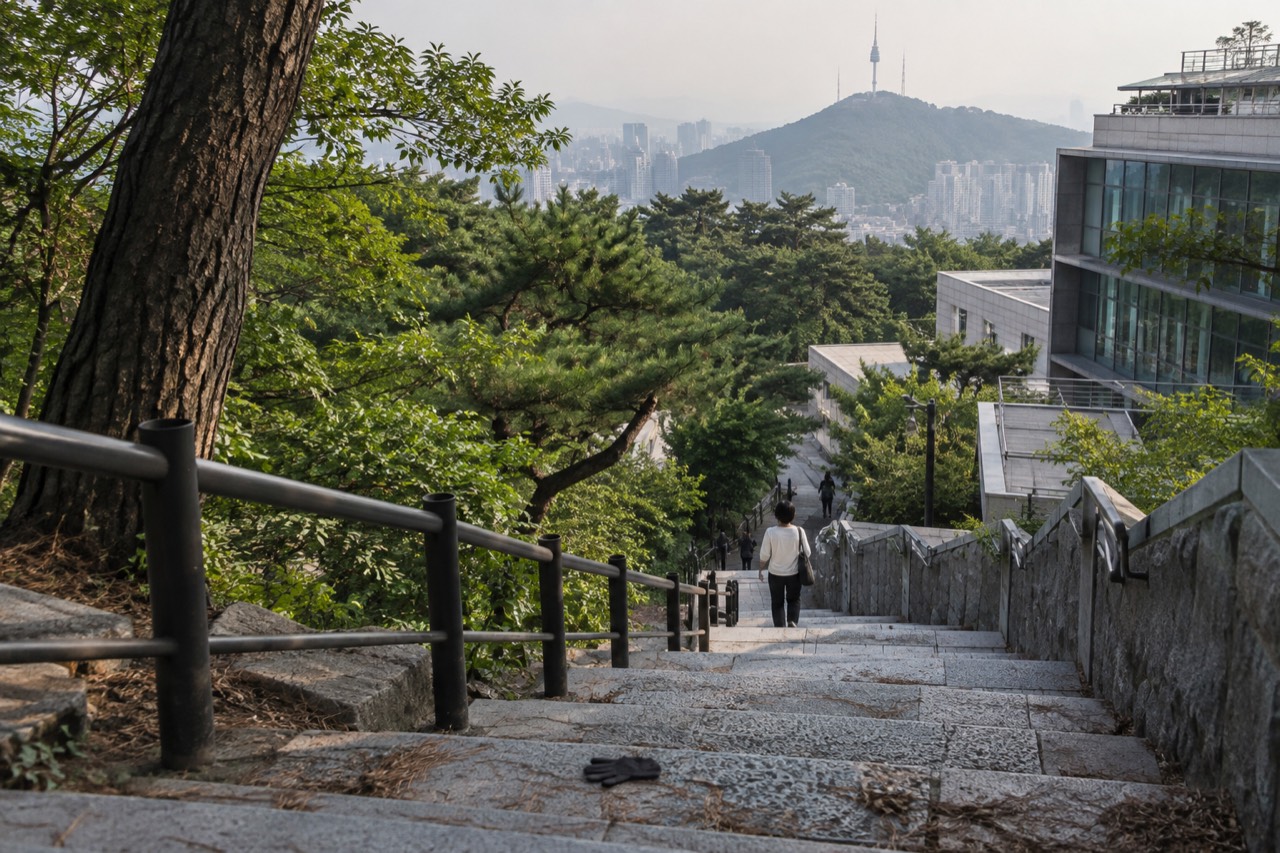
The walk up is moderately hard, and how hard depends almost entirely on the route you pick. The steepest official paths, such as the Sam-soon Steps, take about 40 minutes of continuous climbing on stairs, while the gentler library route takes around 30 minutes on a mix of path and steps. Anyone who finds sustained uphill walking difficult can ride the cable car, the inclined elevator or the circular bus instead.
That is the short version. The longer version is that Namsan is a small mountain, 270.0 m to the point where the tower stands, sitting in the middle of a capital city, and Seoul has spent decades building infrastructure so that almost anyone can get to the top. The tower structure itself is 236.7 m tall, so the summit sits at 506.7 m above sea level, but you are never climbing the tower, only the hill beneath it.
What catches visitors out is not the distance. It is the gradient. The routes that look shortest on a map, the staircases that cut straight up from the southern and northern edges of the park, are the ones that bite, because stairs concentrate all of the climb into a short space. The routes that curve along the circular road are far gentler but longer, and the newest route of all, a barrier-free timber deck path opened in late 2025, was built precisely so that wheelchair users and older visitors could make the summit without touching a single stair.
One thing worth settling early, because it shapes every decision after it: nothing about getting to the top requires a ticket. Namsan Park, the trails, the summit plaza, the terraces around the tower base and the love locks are all free and open to anyone. The only thing on the mountain that is ticketed is the observation deck inside the tower itself. So the question of how hard the walk is, is purely a question of legs and time, not money. If you want the deck view as well as the free summit view, the ticketed product is the one below.
How steep are the trails, really?
Expect sustained uphill on every route, with stairs on the shorter ones and gentler, longer slopes on the circular road paths. The four official summit trails are all paved or stepped, none involve scrambling or exposed ground, and all are walked daily by locals of every age. The difficulty is cardio, not technique.
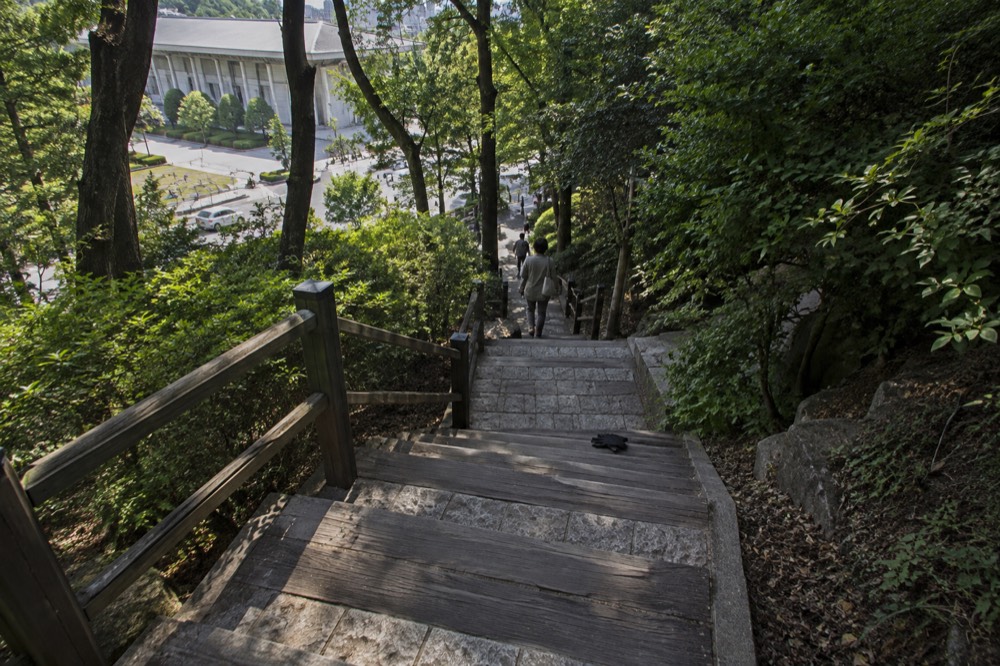
The character of the climb differs sharply between the stair routes and the road routes. The staircases, the Sam-soon Steps being the best known, go up in long straight flights with landings between them. They are shaded by trees for most of their length, which helps in summer, but they offer no let-up: your heart rate stays elevated from bottom to top. Visitors regularly describe them as longer than they look from the base.
The circular road routes are a different experience entirely. They climb at a much gentler angle, winding around the flank of the mountain, and you share them with the Namsan shuttle buses. They take longer, and in warm weather the exposed stretches can be hotter than the shaded stairs, but the effort is spread out. Many walkers go up one way and down the other, taking the stairs on the descent when the knees, not the lungs, are the limiting factor.
Surface underfoot is good throughout. The official trails are paved, stepped or timber-decked, and the city closed the unofficial side paths that walkers had worn into the forest during its 2025 trail works, restoring them ecologically and directing everyone onto the built routes. That means you will not accidentally find yourself on a muddy goat track, but it also means there is no shortcut that avoids the climb. Our Namsan Park walk-up routes guide breaks each path down in more detail.
The four official routes and their published times
The tower's own operator publishes times for four summit walking routes: 40 minutes up the Sam-soon Steps, 30 minutes from Namsan Public Library, 40 minutes from the National Theater of Korea, and 30 minutes up the steps beside the National Theater. These are the only sourced walk times on the mountain, and they assume a steady pace.
Those four figures come from YTN Seoul Tower, the company that owns the tower building, and they are the numbers to plan around. Anything more precise you may read elsewhere, a minutes figure for a route not on this list, has no official source behind it. The table below sets out what each route involves.
| Route | Where it starts | Published time | What it is like |
|---|---|---|---|
| Sam-soon Steps | Beside the Seoul Education Research and Information Institute, up to Palgakjeong | 40 minutes | Long flights of stairs, shaded, famous from the drama "My Lovely Sam-soon" |
| Library route | Entrance to the Southern Circuit in front of Namsan Public Library | 30 minutes | Gentler path and steps mix, passes the cherry blossom walk in spring |
| National Theater route | From the theatre ticket booth via the Southern Circuit | 40 minutes | Road-style climbing on the circular route, steady rather than steep |
| Theater side steps | Steps beside the National Theater of Korea, Southern Circuit then right up the steps | 30 minutes | Shorter stair option on the southern side |
A few honest notes on reading that table. The times are one-way, to Palgakjeong and the summit plaza area, not back down. They also assume you keep moving; visitors who stop for photos, which is most people on a first visit, will take longer. And the two 30-minute routes are not 30 easy minutes, they are 30 minutes of genuine uphill, just at a more forgiving angle than the Sam-soon Steps.
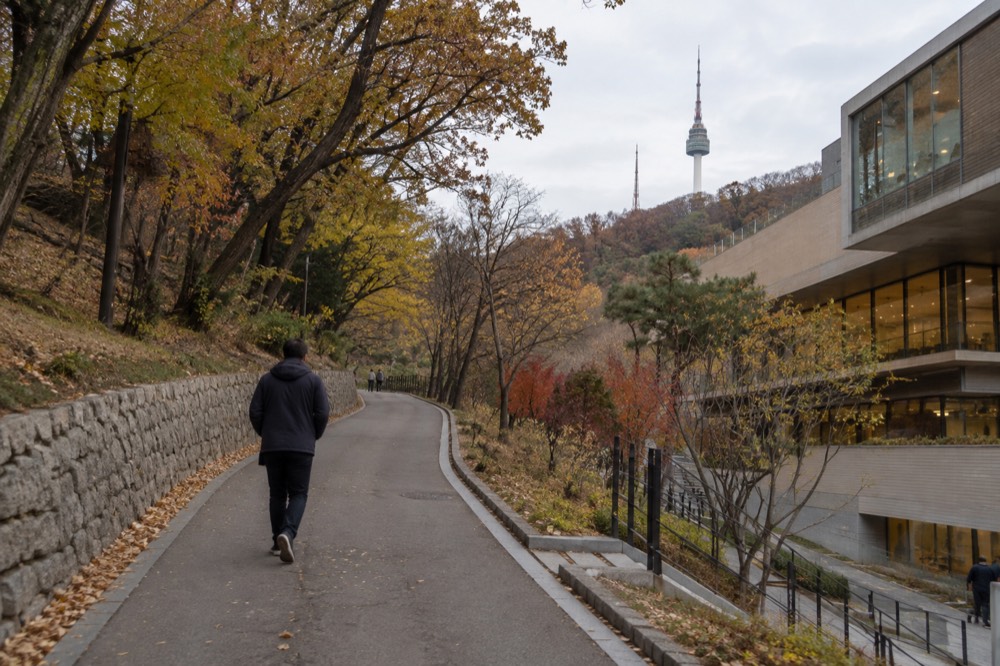
The library route deserves a special mention for spring. Seoul's city government describes Namsan as a famous cherry blossom spot and names the blossom path from Namsan Public Library up to N Seoul Tower specifically. The climb is the same climb, but in early April it runs under blossom, which is a fair trade for the effort. The city's own April Namsan feature covers what else is flowering on the mountain that month.
If you have walked up and want the deck as well, the ticket below is the standard option, rated 4.6 from 34,365 reviews and priced from US$15.25 per adult.
What if you start from Myeongdong?
From Myeongdong you are not walking to the tower, you are walking to the cable car, and that walk is short and mostly gentle. The city publishes 590 m, about 12 minutes, from Myeongdong Station Exit 4 via Namsan Tunnel 3 to the cable car station, and 790 m, about 15 minutes, from Hoehyeon Station Exit 1 via the Ormi elevator route.
This is the distinction that confuses most first-time visitors. Myeongdong sits at the foot of Namsan, and the cable car's lower station is partway up the hill above it, not beside the station itself. The walk between the two is ordinary city pavement with a modest incline, nothing like the summit trails. Once you are at the cable car station you have three ways to finish the job: ride the cable car, ride the free Ormi inclined elevator up to the station if you came the Hoehyeon way, or keep walking. The full index of guides sits on Namsan Tower Seoul.
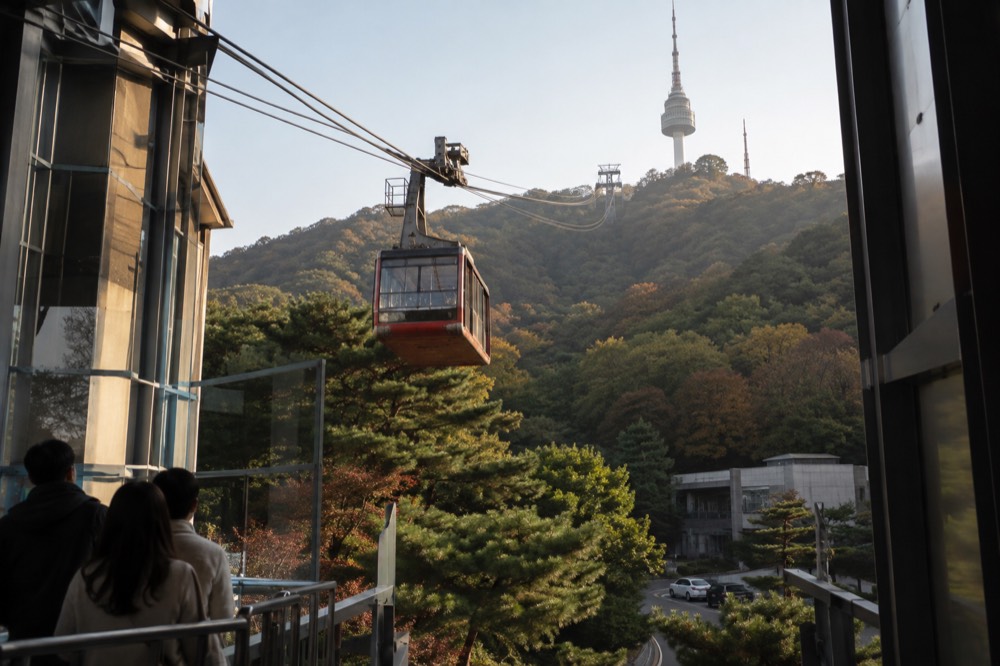
The cable car is a paid ride, a separate company from the tower, with adult fares of KRW 15,000 round trip or KRW 12,000 one way. The Ormi, a glass-walled slanted outdoor elevator running between Namsan Tunnel 3 and the cable car station, is free, runs 09:00 to 23:00 with a maintenance suspension every Monday from 09:00 to 14:00, and is described in full in the city's own Ormi walking guide. The cable car company also runs a free shuttle bus between Myeongdong Station and the cable car platform, first departure 12:00 and last 20:30, for anyone who would rather not do even the short uphill stretch.
One route detail worth knowing: the official pages pair exit numbers with specific routes, because three different official sources give three different exits for three different ways up. Exit 4 at Myeongdong Station serves the Namsan Tunnel 3 route to the Ormi and the cable car; the tower operator's own directions use Exit 3 toward the Pacific Hotel side of the street. Follow the route you have chosen, not the exit number alone. Our guide to getting to N Seoul Tower lays out every option with the exits matched to each one.
If you would rather bundle the deck and the ride together, the combined option below covers the observatory plus the cable car. Note that it requires collecting a physical ticket at a partner shop in Myeongdong first, and collection closes at 18:00, which matters if you are planning a late evening up the mountain.
Who should take the bus instead?
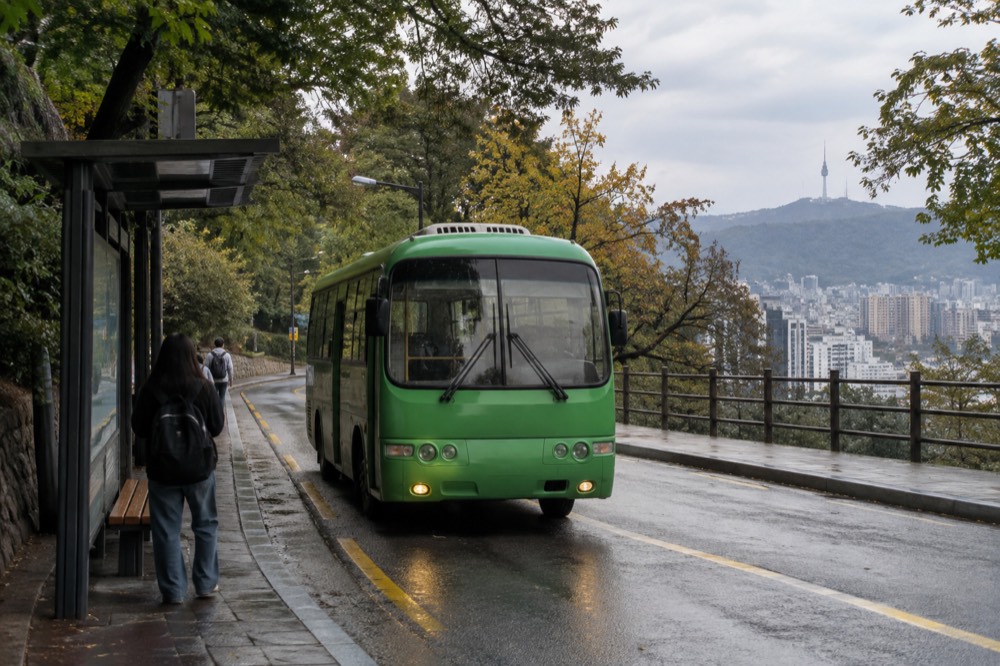
Take the bus if you have knee or heart trouble, if you are visiting with small children or older relatives, if the weather is hot and humid, or if you simply want to save your legs for the summit itself. The Namsan circular buses 01A and 01B cost KRW 1,500, run every 9 and 14 minutes respectively, and operate 06:30 to 23:00.
Both circular routes board at Chungmuro Station, on Lines 3 and 4, or Dongguk University Station on Line 3, and stop at N Seoul Tower. 01B also serves the Namsan Cable Car and the walking-trail entrance stop, which makes it useful for one-way itineraries: bus up, walk down, or the reverse. Payment is by transport card on the operator's English page. There is no shame in any of this; the buses exist precisely because the city wants the summit open to everyone, not only to people who can climb stairs.
Private cars, for the record, cannot drive up at all. General vehicle access to Namsan has been restricted since 1 May 2005 for ecological protection, with further restrictions on tour buses since August 2021, so the bus, the cable car, the Seoul City Tour Bus or your own feet are the complete list of options. The operator's transport page sets out the full access rules.
Heat deserves a real mention here. Seoul summers are humid, and the stair routes offer shade but no breeze. Visitors reporting through mid-2026 consistently describe weekends, holidays and evenings as the busy windows and weekday mornings as the calm ones, and the cable car company's own advice says mornings are quieter than afternoons. No official source anywhere publishes a wait time, so plan around crowds qualitatively: go early, go on a weekday, or take the bus and skip the question entirely.
The new barrier-free trail changes the answer
Since 25 October 2025, Namsan has a barrier-free timber deck path, the Namsan Sky Forest Trail, built so that wheelchair users, older visitors and anyone who cannot manage the steep old paths can get up the mountain. It links the Huam-dong Namsan Fitness Center to the Namsan Library, with named stops including a glass-fenced Sunset Observatory.
This is the single biggest change to walking on Namsan in years, and almost no published guide mentions it. The Seoul Metropolitan Government built it with the Korea Forest Service, which provided the national forest land while the city paid for the work, and the project announcement names the stops along it: the Sunset Observatory, a glass-fenced sky-view photo point, the Wind View Bridge over a metasequoia stand, a Pine Rest Area, and a Wellness Garden with a Starlight Marronnier Forest and meditation gardens, ending at Sowol Garden by the Namsan Library entrance.
For the purposes of this question, what matters is the phrase barrier-free. For the first time, "is it hard to walk to the N Seoul Tower" has an official answer of "it does not have to be". A visitor using a wheelchair, or walking with a stick, or simply wanting a gentle graded deck instead of stairs, now has a purpose-built route to the library, from which the library summit trail continues. Two shorter deck sections were completed in the first half of 2025 as well, one along the southern circular road and one running from the tower down to the northern circular road.
The city also added something for the descent-minded: that free guided night walk, with a licensed city culture-and-tourism guide leading the way and the route finishing at Palgakjeong, deliberately positioned for a walk down to Namdaemun Market afterwards. It is booked in advance through the city's own walking-tour site. A guided evening walk down, with someone else handling the route, is a fine answer to tired legs.
So, is the walk worth it?
For most reasonably fit visitors, yes: the climb is 30 to 40 minutes of honest uphill on good surfaces, through forest, and the free summit plaza and terraces at the top are the reward. For anyone with mobility limits, small children or summer heat to contend with, the cable car, the free Ormi elevator and the KRW 1,500 circular bus deliver the same summit without the climb.
The choice is genuinely free in both senses. Walking costs nothing and buys you the forest, the quiet of the trails and the satisfaction of the climb. Riding costs a little or nothing, depending on whether you pick the cable car, the elevator or the bus, and buys you energy to spend on the summit instead. The observation deck inside the tower is the only thing on the mountain behind a ticket, and everything else, the plaza, the love locks, the beacon mound, the city wall path and the views from the base, is open to however you arrived.
If the deck is part of your plan, the options below cover the three most common ways to buy it: the standard ticket, the ticket bundled with the cable car, and a fast-track version for anyone who would rather not stand at the ticket counter.
Common questions about walking to N Seoul Tower
Is It Hard To Walk To The N Seoul Tower?
It is a moderate hill climb rather than a hike. The official routes take 30 to 40 minutes of sustained uphill on paved paths and stairs, with the Sam-soon Steps the steepest and the library route the gentlest at its angle. Anyone who would rather not climb can take the cable car, the free Ormi inclined elevator or the KRW 1,500 circular bus.
How long does the walk up take?
The tower's operator publishes four times: 40 minutes up the Sam-soon Steps, 30 minutes from Namsan Public Library, 40 minutes from the National Theater of Korea via the Southern Circuit, and 30 minutes up the steps beside the National Theater. These are one-way figures at a steady pace, and most first-time walkers take longer with photo stops.
Can you walk from Myeongdong?
Yes, but the walk from Myeongdong goes to the cable car station, not the summit. The city publishes 590 m, about 12 minutes, from Myeongdong Station Exit 4 via Namsan Tunnel 3, and 790 m, about 15 minutes, from Hoehyeon Station Exit 1 via the Ormi route. From the cable car station you can ride up or continue on foot.
Is there an easy route for wheelchairs or older visitors?
Yes. The Namsan Sky Forest Trail, opened on 25 October 2025, is a barrier-free timber deck path linking the Huam-dong Namsan Fitness Center to the Namsan Library, with rest areas and observatory stops along it. It was built specifically so that wheelchair users and visitors who cannot manage steep paths can enjoy the mountain.
Do you have to walk, or can you ride?
Nobody has to walk. The cable car runs 10:00 to 23:00 every day, the free Ormi inclined elevator runs 09:00 to 23:00 except Monday mornings, and the circular buses 01A and 01B run every 9 and 14 minutes from Chungmuro or Dongguk University stations, 06:30 to 23:00, for KRW 1,500. Private cars have been barred from the mountain since 2005.
Is the walk free?
Completely. Namsan Park, all the trails, the summit plaza, the terraces around the tower base and the love locks cost nothing. The only ticketed thing on the mountain is the observation deck inside the tower itself.