Things to Do in Seoul: The First-Time Visitor Shortlist
Seoul rewards a shortlist, not a checklist. This guide puts the palaces, markets, neighbourhoods and the tower in order, separates what is free from what is not, and folds in what has actually changed in the city this year.
Short answer
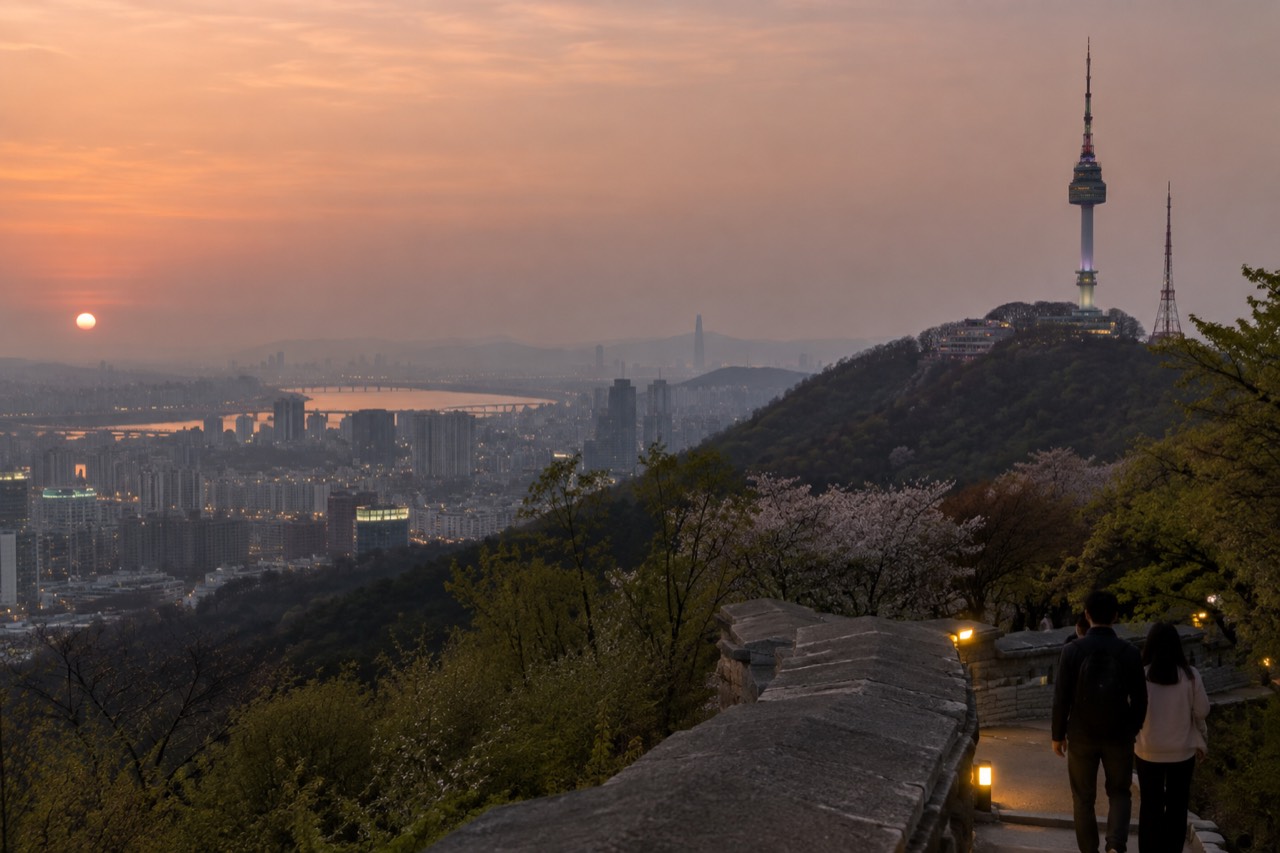
First-time visitors should build a Seoul trip around Gyeongbokgung palace, Bukchon and the riverfront, Myeongdong for food and shopping, Gwangjang Market for eating, and N Seoul Tower for the city view. The observatory ticket costs from US$15.25 online, while Namsan Park, the summit plaza and the love locks below the deck are all free.
What are the best things to do in Seoul for first-time visitors?
The core shortlist is Gyeongbokgung palace and its guard-change ceremony, the hanok lanes of Bukchon, the eating halls of Gwangjang Market, the Myeongdong shopping district, a riverside stretch of the Hangang, and the view from N Seoul Tower on Namsan. Each sits inside the central belt of the city, and a visitor with three or four days can cover all of them at a human pace without crossing the city twice a day.
Seoul is a capital where the headline sights cluster unusually tightly. The Joseon palaces, the traditional neighbourhoods, the big markets and the Namsan massif all sit within a few metro stops of one another, which is why first itineraries tend to converge on the same handful of places. That convergence is not a problem. It is the city working as designed.
The mistake most first-timers make is the opposite: trying to add too much. Day trips to the DMZ, palace number four, a fourth night market and two themed cafes in one afternoon is how a trip turns into a commute. A better frame is to pick one anchor per half-day, one neighbourhood to wander afterwards, and let the gaps happen. Seoul is a city that repays wandering more than it rewards ticking off.
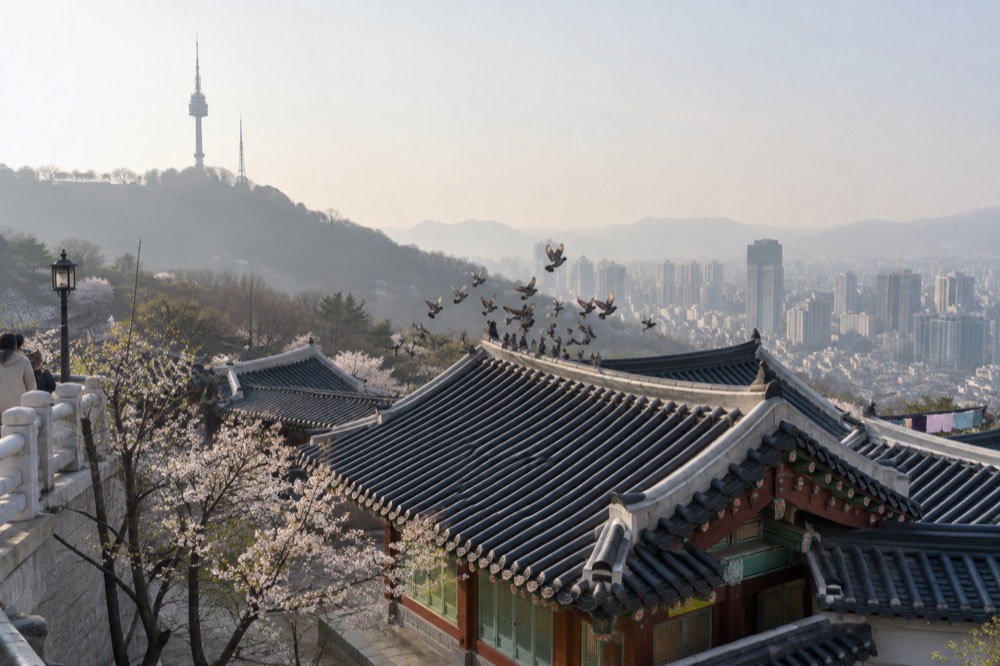
N Seoul Tower belongs on the list for a specific reason. It is the one sight that puts the whole city in a single frame, and the mountain it stands on is itself one of the largest civic parks in Seoul, divided into four districts according to the city's official tourism site. The tower's observation deck is the paid part; almost everything around it is not, a distinction this guide returns to in full later.
If you want the day-by-day version rather than the category version, our three-day Seoul itinerary sequences these same sights with a realistic daily rhythm, including where the tower fits on the busiest day.
How do you fit Seoul's highlights into a short trip?
Group the city by area and give each cluster half a day: the palace-and-Bukchon block north of Jongno, the markets and Myeongdong block in the centre, the riverfront for an evening, and Namsan for a half-day that can stretch from a summit walk to a night view. Most first-time routes work best as two clusters a day, with the tower scheduled late so the view carries into the evening.
The palace cluster comes first for most visitors, and rightly. Gyeongbokgung is the largest of the Joseon palaces, and the changing of the royal guard at its main gate draws a crowd for good reason. Nearby Bukchon preserves clusters of hanok, the tiled traditional houses, along lanes that rise between two palaces. The etiquette note that matters here is simple: people live in those houses, and the neighbourhood's signage asks for quiet. Photograph the roofs, not the living rooms.
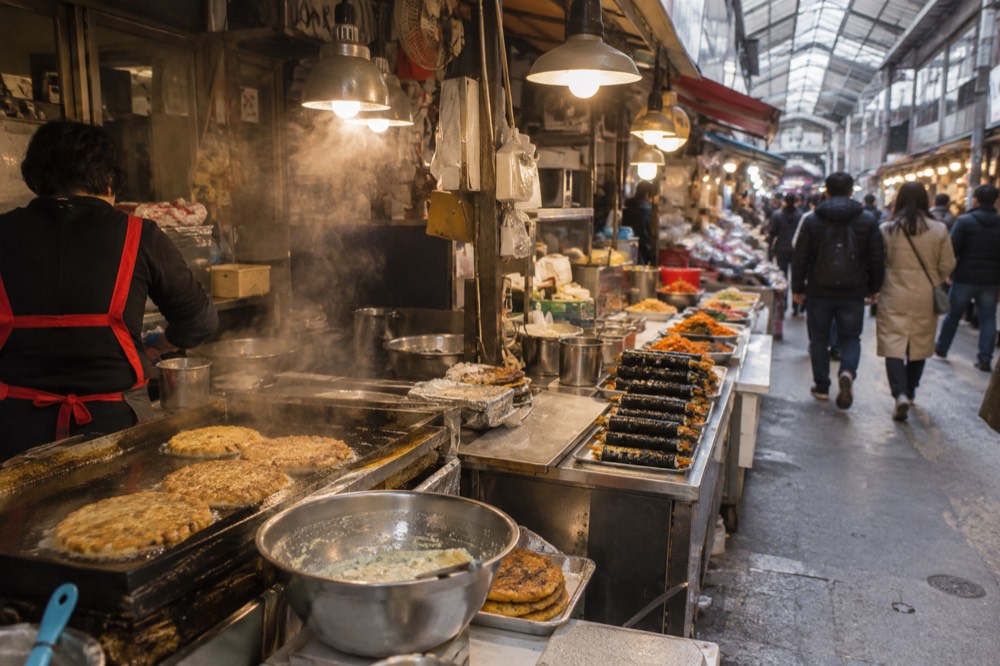
The eating cluster is Gwangjang Market, a covered market older than most of the city's skyscrapers, where the bindaetteuk mung-bean pancake stalls and the mayak gimbap rows have their own followings. Myeongdong sits a short hop south, and it is the district most foreign visitors end up knowing best: a dense grid of street food, skincare shops and fashion flagships at the foot of Namsan. If you are basing the trip around the tower, our guide to what Myeongdong is famous for covers the district in detail.
Here is the honest sequence for a first visit, assuming four days and no car (you cannot drive up Namsan anyway; private vehicle access has been restricted since 2005):
| Day | Morning | Afternoon | Evening |
|---|---|---|---|
| 1 | Gyeongbokgung and the guard ceremony | Bukchon lanes, Insadong tea houses | Jongno or Cheonggyecheon stream walk |
| 2 | Gwangjang Market early | Myeongdong shopping and street food | Namsan summit and the tower at night |
| 3 | A second palace or the National Museum | Itaewon or Seongsu cafes | Hangang riverside park |
| 4 | Namsan Park trails and Bongsudae | Seoul City Wall path | Palgakjeong pavilion night view |
The tower slot on day two is deliberate. The observatory is open until 22:30 on weekdays and 23:00 on weekends and public holidays, with last admission 30 minutes before closing, so an evening visit never collides with dinner. Visitors consistently report that evenings, weekends and holidays are the busy windows and weekday visits the quiet ones, which is worth knowing before you lock the schedule.
If the deck is on your list, the ticket options are straightforward: the observatory on its own, the observatory bundled with the cable car ride, or a fast-track version of the deck ticket.
Is N Seoul Tower worth adding to a Seoul itinerary?
Yes, for one reason above all: no other vantage point shows the whole capital in one frame, and the operator states that on a clear day the deck can see up to 50 km, from Bukhansan in the north to Gwanaksan in the south. The tower is also the city's most recognisable single structure, a working broadcast tower whose lighting has signalled Seoul's air quality since 2011, and the observation deck is open every day of the year.
The honest framing is that the tower is one experience split in two. The mountain is free. Namsan Park, the summit plaza, the terraces around the tower base, the Palgakjeong pavilion area, the love locks, the Bongsudae beacon mound, the Seoul City Wall path and the Seoul Tower Plaza shops and cafes all cost nothing and need no ticket. A visitor can reach the summit, see the view from the base and walk the whole plaza for free.
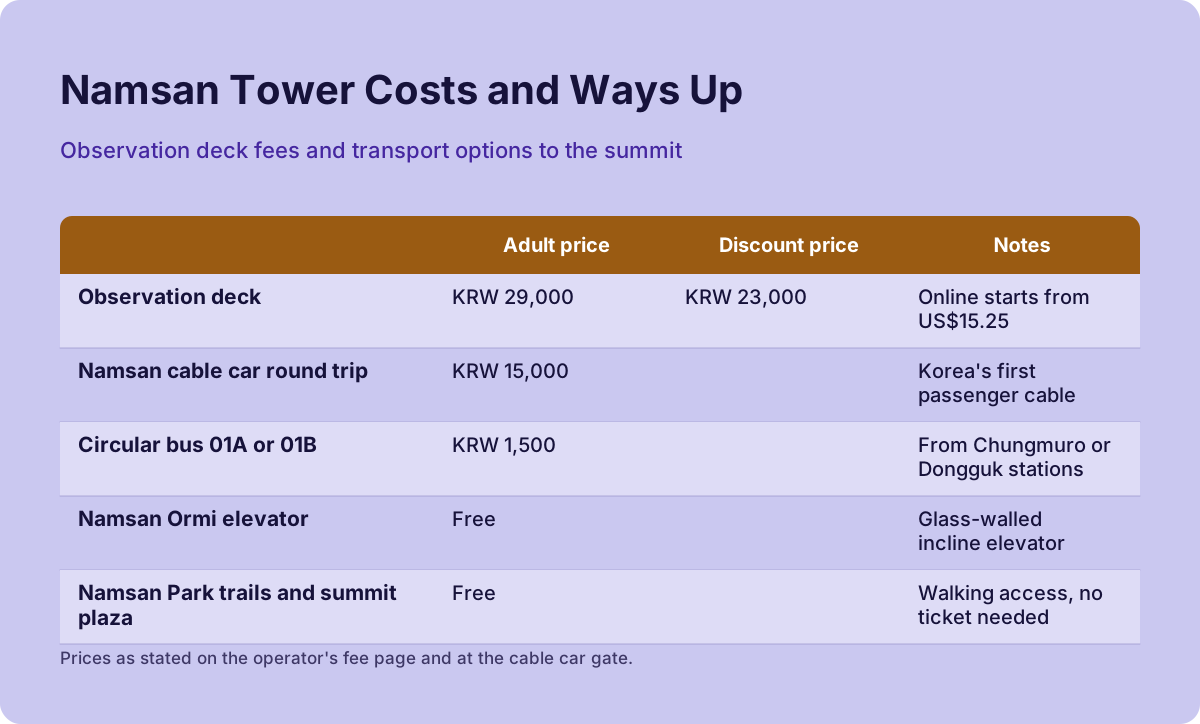
The paid part is narrow: the observation deck inside the tower. The operator's own fee page prices it at KRW 29,000 for adults and KRW 23,000 for children and seniors, while welfare-card holders get 30% off admission, grades 1 to 3 also covering one companion. Online the same ticket starts from US$15.25. Both prices are stated here as themselves, because comparing them numerically is exactly the kind of arithmetic that misleads. What the deck adds over the free base is height, glass and shelter: indoor levels, digital telescopes with optical zoom up to 36x, and the rotating n.GRILL restaurant above it, which makes one full rotation in 1 hour 40 minutes.
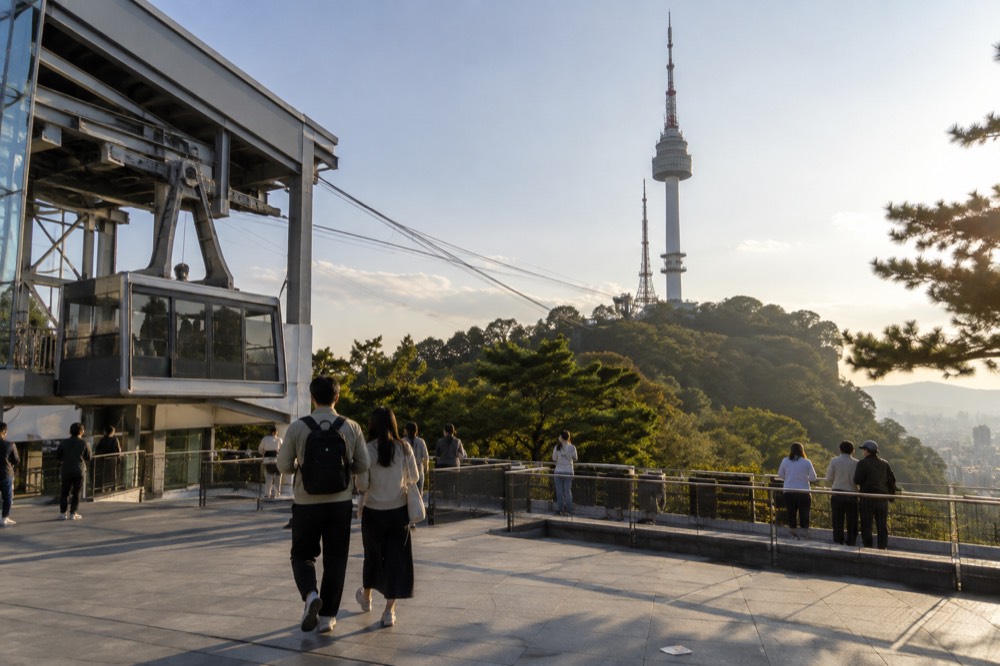
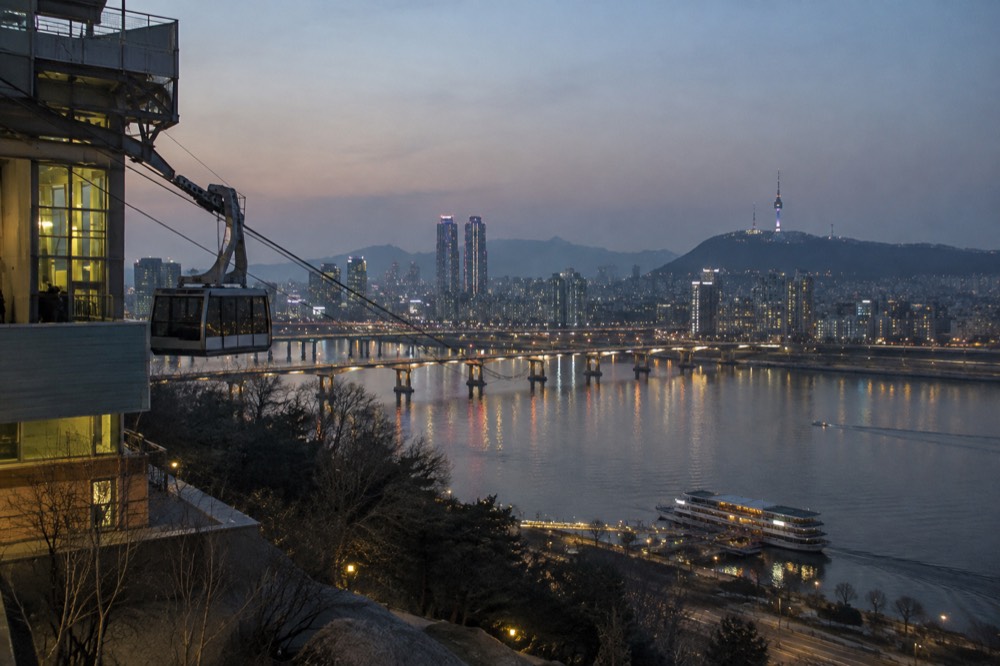
Getting up is part of the outing. The Namsan cable car has run since 1962 and presents itself as Korea's first passenger cable car; an adult round trip costs KRW 15,000 at the gate. The free alternatives are the Namsan Ormi, a glass-walled inclined elevator between Namsan Tunnel 3 and the cable car station, the circular buses 01A and 01B from Chungmuro or Dongguk University stations at KRW 1,500 a ride, and the walking trails themselves, including the new barrier-free Namsan Sky Forest Trail opened by the city in October 2025. Our how to get to N Seoul Tower guide maps every option.
One planning detail that catches people out: the observatory-plus-cable-car option sold through booking sites is a package, not an operator product, and it requires collecting a physical ticket at a partner shop in Myeongdong before riding, with collection closing at 18:00. The tower operator and the cable car company are separate businesses and neither sells a combined ticket at its own counter.
What should you eat in Seoul?
Eat Korean barbecue at least once, then work outward: bindaetteuk and mayak gimbap at Gwangjang Market, tteokbokki and hotteok from street carts in Myeongdong, a proper Korean grill dinner, and the noodle and dumpling traditions of the older downtown. Seoul's food culture is dense and cheap at the bottom end and excellent at the top, and the market stalls are where first-timers eat best per won spent.
Start at Gwangjang Market, where the stalls rather than the restaurants are the attraction. The market's bindaetteuk row fries mung-bean pancakes to order, and the mayak gimbap stalls serve the small "drug" gimbap rolls with a mustard dip that regulars order by the plate. Yukhoe, Korean beef tartare, has its own corner of the market with vendors who have done one thing for decades.
Myeongdong is the street-food district, and it peaks in the evening when the carts come out. Grilled cheese lobster tails, tornado potatoes, hotteok sweet pancakes and egg bread all circulate in a few blocks. The district also gained a large new Olive Young store in March 2026, which matters if your trip combines eating with a skincare run.
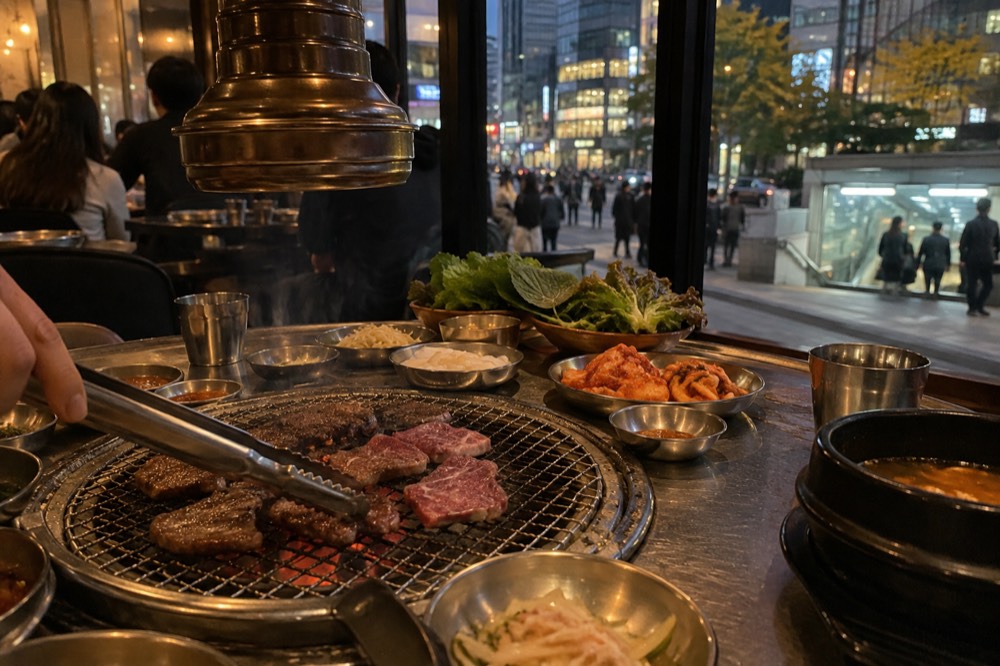
For a sit-down dinner, Korean grill is the tradition most worth booking. HanCook, the Korean grill restaurant on the tower's third floor, is one option that combines dinner with a view, and dining there earns a discount on observatory admission; an advance reservation at n.Grill, the French restaurant above the deck, includes free observatory entry. Our N Seoul Tower restaurants guide covers every floor.
At the summit, the casual options run from N Burger, which reopened in March 2026 after its renewal as a K-style handmade burger house with a Seoul bulgogi burger on the menu, to the Seoul Tower Plaza food court below the tower, where 33 Tteokbokki and Mini Gimbap, Mom's Touch and bhc Chicken all sit on the free-access floors. One rule to know: the tower operator does not allow outside food inside the building and directs visitors with packed meals to the plaza in front of Palgakjeong.
The observatory ticket on its own is the cheapest way into the deck, and pairing it with a summit dinner is a common pattern.
Where should you shop and wander in Seoul?
Myeongdong for skincare, street food and fashion in one dense grid; Insadong for tea, craft and souvenirs; Hongdae for youth fashion and nightlife around the university; and Gangnam for flagship stores and the upmarket side of the city. First-timers with limited time should pick Myeongdong and Insadong, which sit closest to the palace and Namsan clusters, and treat the others as optional.
Myeongdong is the default base for a lot of foreign visitors, and the reasons are practical: it is central, it is on Line 4 with a station serving both the district and the walk to Namsan, and it has the densest concentration of shops, street food and hotels in the downtown area. It is also the district at the foot of the cable car's free shuttle bus, which runs from Myeongdong Station to the cable car platform with a first departure at 12:00 and a last at 20:30. The wider set of guides lives on Namsan Tower Seoul.
Insadong is the craft-and-tradition counterweight, a district of galleries, tea houses and souvenir lanes between the palaces and the river. It is the place for a proper tea stop after a morning of palace walking, and it connects on foot to Bukchon and to Jogyesa, the head temple of Korean Buddhism, whose main gate sits right on the district's edge.
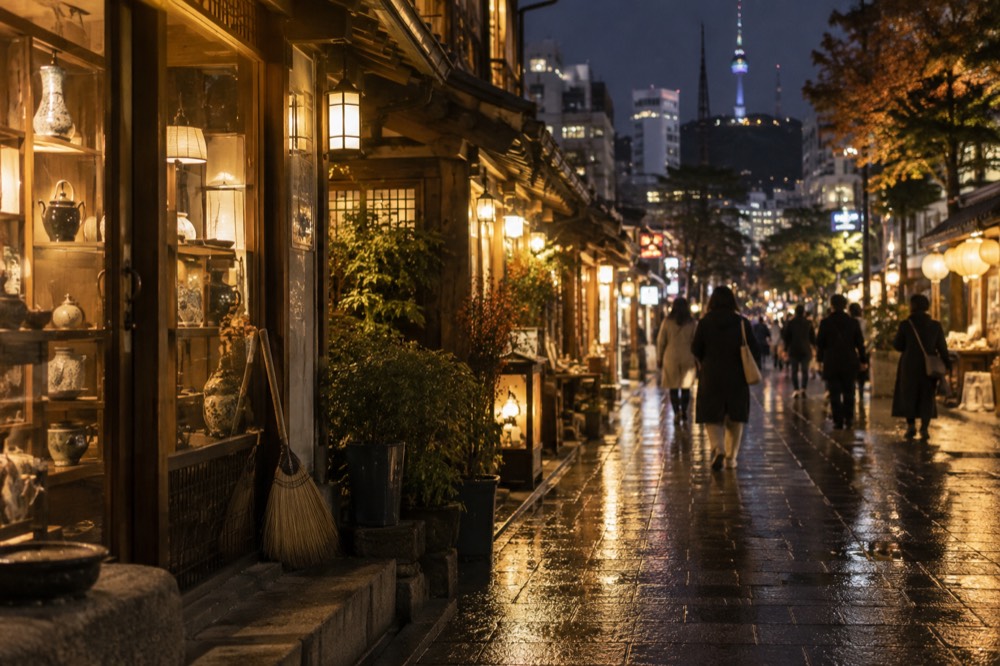
Hongdae, west of the centre, is the student district: indie fashion, busking, themed cafes and the loudest nightlife in the city. Gangnam, south of the river, is the corporate and luxury face, with the flagship stores along Apgujeong and Garosu-gil. Neither is essential on a short first trip, and both are easy metro rides when a spare evening appears.
| District | Best for | Character | Time to give it |
|---|---|---|---|
| Myeongdong | Skincare, street food, fashion | Dense, loud, central | An evening |
| Insadong | Tea, craft, souvenirs | Quiet, traditional | A morning |
| Bukchon | Hanok lanes, photos | Residential, hilly | Two hours |
| Hongdae | Youth fashion, nightlife | Energetic, student | A late afternoon into night |
| Gangnam | Flagship stores, dining | Polished, upmarket | A half-day |
A newer addition to the central-city list opened only this month: K-Culture Station, a 335-metre underground passage 13 metres below Seoul Plaza that had been sealed for more than four decades before reopening on 7 September 2026 as a cultural venue, launching with an immersive exhibition for Big Bang's twentieth anniversary. It sits between City Hall and Euljiro 1-ga stations, a short walk from the Myeongdong side of the centre, and no printed guide yet mentions it.
What can you do in Seoul for free?
A great deal: the Bukchon lanes, Cheonggyecheon stream, the Hangang riverside parks, Namsan Park in its entirety including the summit plaza and the love locks, the Namsan Ormi elevator, and, since September 2026, a free city-run guided night walk over the Namsan summit itself. The free side of Seoul is not the consolation prize; some of the best views and evenings in the city cost nothing.
The free headline is new. Seoul's free guided walking-tour programme added a Namsan City Wall night course in September 2026, taking its night courses from nine to ten. It runs every day with departures at 18:00 and 20:00, led by a licensed city culture-and-tourism guide, starting at the Namsan Sky Forest Trail entrance near the Sowol poetry monument garden, passing the observatories and the wellness garden, then N Seoul Tower and the love lock deck, and finishing at Palgakjeong, deliberately positioned for a descent toward Namdaemun Market and dinner. Booking is free but made in advance through the city's own walking-tour site rather than on the day, per the city's official announcement.
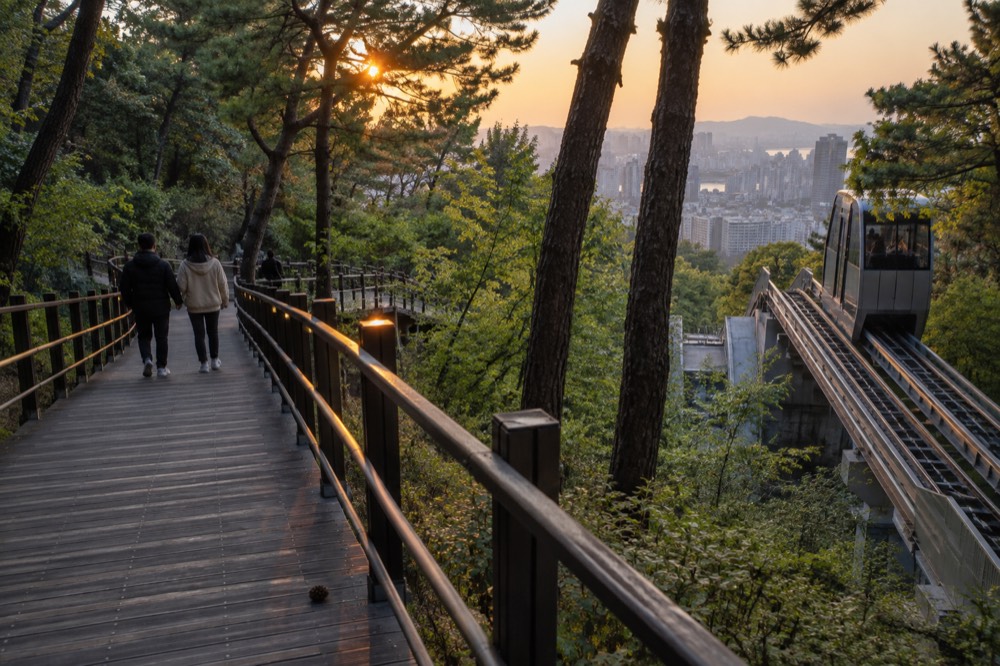
The trail that walk starts on is itself new. The city opened the Namsan Sky Forest Trail on 25 October 2025, a barrier-free timber deck path built so wheelchair users, older visitors and anyone defeated by the steep old paths can get up the mountain, linking the Huam-dong fitness center to the Namsan Library. The city closed and ecologically restored the unofficial side paths worn into the hillside at the same time, so walkers are now directed onto official trails only.
Beyond Namsan, the free list includes the Cheonggyecheon stream walk through the downtown, the Hangang riverside parks with their evening crowds, the Bukchon and Seochon lanes, and the Namdaemun and Gwangjang market wanderings, which cost nothing until you start eating. Our is it free to go up Namsan Tower post settles the tower-specific version of the question in detail.
| Activity | Cost | Notes |
|---|---|---|
| Namsan Park, summit plaza, love locks | Free | No ticket of any kind |
| Namsan Ormi inclined elevator | Free | Suspended Mondays 09:00 to 14:00 for maintenance |
| Cable car company's Myeongdong shuttle bus | Free | First departure 12:00, last 20:30 |
| City-run Namsan night walk | Free | Book in advance, daily 18:00 and 20:00 |
| Seoul Tower Plaza shops and cafes | Free entry | You pay only for what you buy |
| Observation deck inside the tower | Paid | From US$15.25 online, KRW 29,000 at the operator's desk |
The deck remains the one paid item on the mountain, and the fast-track version of the ticket is the option for anyone who wants the ticket-counter step removed from their evening. It is worth being precise about what that means: it skips the ticket counter, and riders of the cable car still queue for the cable car. One buyer of the fast-track option reported no visible fast-track lane on their visit.
What should you know before you go?
Three practical things changed recently: Seoul's flat-rate 30-day transport pass was withdrawn on 31 August 2026 and its replacement is for residents only, the K-ETA entry waiver for visa-exempt nationals runs to the end of 2026, and you cannot drive up Namsan, so the trip plan should assume metro, bus, cable car or feet. None of this is complicated, but all of it contradicts older guides still circulating online.
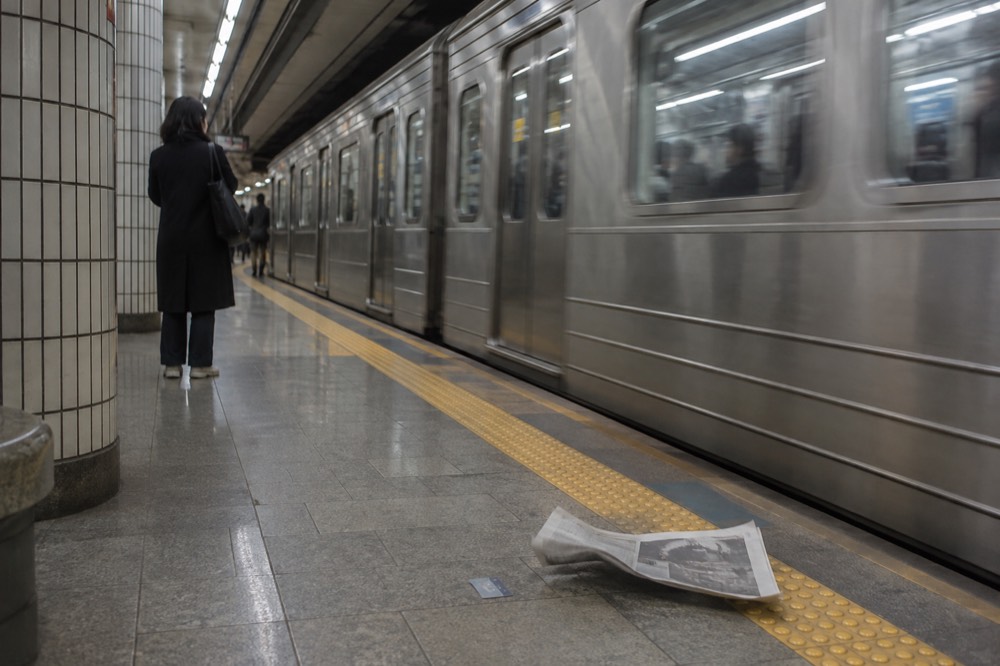
The transport pass point matters because almost every published Seoul itinerary recommends the old Climate Card. The Seoul Metropolitan Government's own page carries a discontinuation notice: the 30-day prepaid card could be recharged only until 31 August 2026, and the replacement Climate Pass, released 1 September 2026, is available to Seoul residents, with eligibility based on place of residence and benefits starting the month after registration. A visitor cannot use it. What a visitor can still do is charge short-term passes, in one-, two-, three-, five- and seven-day lengths, onto an existing Climate Card; the city's official climate card page carries the current fare table and the vending-machine locations.
Entry is simpler than many guides suggest. The Korea Tourism Organization states the temporary K-ETA exemption for nationals of visa-exempt countries has been extended until 31 December 2026, so no electronic travel authorisation is needed for a short visit, though those who apply anyway get perks such as skipping the arrival card. The official notice is on the KTO's own notice page.
A few Seoul-specific rules worth knowing: the whole Namsan area is non-smoking under the National Parks Act, with a stated fine of KRW 100,000. Pets are not allowed inside the tower itself, though the shared plaza area run by the tower's owner allows leashed pets subject to each store's rules, a split that exists because two different companies run the tower and the plaza. Wheelchairs and strollers can be borrowed at the tower's information desk. And the observatory's own published closing time, 22:30 weekdays and 23:00 weekends, with last admission 30 minutes before, is the only fixed clock fact on the mountain: no operator or city source publishes a time for when the exterior lighting comes on, despite the confident switch-on times that circulate in third-party guides.
Season-wise, one honest note. Seoul's cherry blossom average, measured at the designated standard tree at the Seoul Weather Observatory, is flowering on 8 April and full bloom on 10 April, but that is a Seoul-wide figure, not a Namsan one, and no Namsan-specific bloom date exists. The city describes the blossom path from Namsan Public Library up to the tower as a famous spring walk, which is the reliable way to say it. For winter trips, the city's December festival dates for the coming season have not been published yet, so plan around the markets and the lit-up streets rather than a dated festival claim.
Where should you stay for a first Seoul trip?
Stay central: Myeongdong or Chungmuro put you between the palaces, the markets and the Namsan cable car's lower station, and Euljiro and Jongno put you in the older downtown at slightly lower rates. South of the river suits a second visit better. The one fresh change is that The Plaza, the landmark hotel on Sogong-dong in Jung-gu, ceases operations on 30 September 2026 for a multi-year remodel, so anything still recommending it is out of date.
The practical logic is transport. The cable car's base station is up the hill from Myeongdong, the circular buses to the summit board at Chungmuro and Dongguk University stations, and the Myeongdong shuttle bus ties the district directly to the cable car platform. A hotel anywhere in that triangle puts the tower, two palace clusters and the big markets within a short metro hop or a walk. Our where to stay near Namsan guide compares the districts properly.
Budget travellers should know that Myeongdong's density works in their favour too: the district's guesthouse stock is deep, and the street food keeps evening costs down. Mid-range visitors get the best value in Euljiro, whose print-shop alleys have been quietly converting into small hotels and bars for years. The luxury tier clusters around City Hall and Gangnam, and Centre Pompidou Hanwha, a Seoul outpost of the Paris museum that opened in Yeouido on 4 June 2026, has added a new reason to cross the river for an afternoon.
Whichever base you choose, the tower visit itself is best treated as an evening: the cable car company's own guidance names sunset-to-night as its recommended riding window, and the deck's late hours mean the view is available long after the palace gates have shut. The observatory-plus-cable-car option pairs the two halves of that evening in one purchase, with the Myeongdong pick-up step built in.
The shortlist, then, holds: palaces and Bukchon, markets and Myeongdong, the river, and the mountain with its tower. Every item sits in the central belt, every item is reachable without a car, and the tower is the one that ties the whole city together in a single look. If you are still assembling the trip, the same trio of ticket options covers the paid part of the summit evening.
Common questions about things to do in Seoul
How many days do you need in Seoul?
Three days covers the palace cluster, the markets, Myeongdong and Namsan with room to breathe; four or five lets you add Hongdae, Gangnam or a day trip. Our three-day itinerary page sequences the core sights day by day.
Is N Seoul Tower worth it if you are short on time?
Yes, because the free part of the mountain, the summit plaza and the views from the base, costs nothing and needs no ticket, and the paid deck adds height and shelter. An evening visit fits after dinner, since last admission is 30 minutes before the 22:30 or 23:00 closing.
What is the best area to stay in Seoul for sightseeing?
Myeongdong, Chungmuro or Euljiro, all of which sit between the palaces, the markets and the Namsan cable car's lower station. The Plaza hotel in Sogong-dong ceases operations on 30 September 2026 for a multi-year remodel.
Can you do Seoul without speaking Korean?
Yes. Metro signage is bilingual, translation apps cover menus, and the main tourist districts are used to foreign visitors. The city's free guided walking tours, including the new Namsan night walk, are led by licensed guides and booked in advance online.
Do you need a transport pass in Seoul?
The old flat-rate 30-day Climate Card was withdrawn on 31 August 2026 and its replacement is for Seoul residents only. Visitors can still charge short-term passes of one to seven days onto an existing Climate Card, or simply use a standard rechargeable transport card.
What is free in Seoul?
Namsan Park including the summit plaza and love locks, the Namsan Ormi elevator, the Myeongdong shuttle bus, the city's guided walking tours, Cheonggyecheon stream, the Hangang parks and the Bukchon lanes. Only the tower's observation deck, the cable car if you ride it, and the circular bus fare are paid on the mountain.